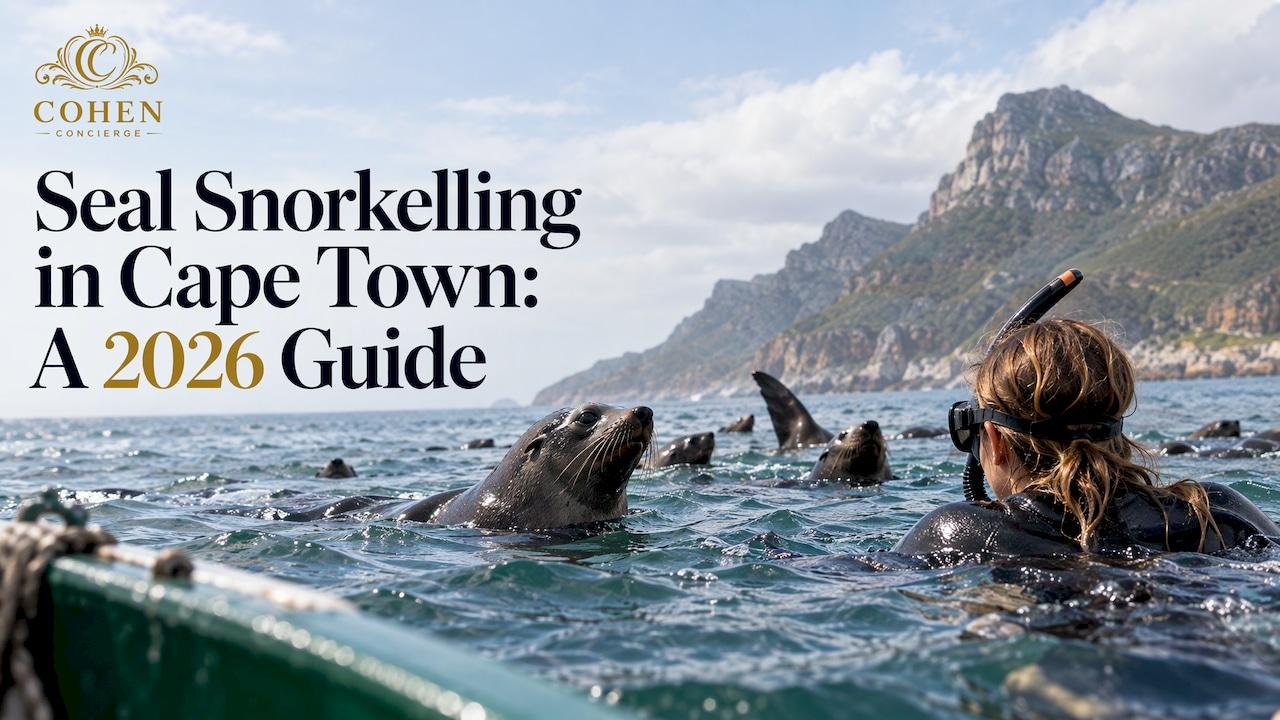
Snorkelling with Cape fur seals has long been one of the most memorable things to do in Cape Town, but the picture changed in 2024 when rabies was found in the seals. Many operators moved their in-water trips away from busy colonies, so the right plan today is a well-supervised, small-group ocean day, with the water time chosen on the day by the guides rather than fixed months ahead. We can arrange that for you, built around the sea conditions, your group and a backup if the ocean says no.
Below: what a classic trip looks like, when the water works best, what has changed, how to behave around seals, and what to do if your day on the water is cancelled.
TL;DR
- A classic seal snorkel is a short boat ride from Hout Bay to Duiker Island, then about 40 minutes in shallow, cold water in a thick wetsuit.
- The season runs roughly October to April, with summer the calmest. Weather can cancel any trip.
- Since rabies appeared in Cape fur seals, several operators have stopped in-water seal sessions or switched to kelp-forest snorkelling. Confirm what is running before you plan around it.
- Never touch seals, leave the water if one behaves oddly, and seek urgent medical care after any bite, scratch or lick.
- We plan the whole day around it: transfers, the right operator for your group, a backup and the meal afterwards.
Table of Contents
- What a classic Cape Town seal snorkel involves
- When the water works best
- What changed: seals and rabies
- How to behave around Cape fur seals
- Where to snorkel around the Peninsula
- Planning the day around the water
- Arranging it with Cohen Concierge
- Our view
- FAQ
- Sources
What a classic Cape Town seal snorkel involves
The best-known version of this trip runs from Hout Bay harbour on the Atlantic side of the Peninsula. According to African Diver, the whole outing takes about two and a half hours. You are fitted with a 5mm wetsuit, hood, gloves, booties, fins and a mask, then take a boat ride of about five minutes to Duiker Island. You snorkel for roughly 40 minutes in shallow water, no deeper than about 5 metres, with two guides and a red buoy marking the area. Afterwards there is hot chocolate and warm water poured down the wetsuit.
Duiker Island is small: about 77 by 95 metres, home to up to 15,000 Cape fur seals, according to the same account. That density is why the experience is so vivid. Seals are curious, and they swoop, spin and blow bubbles around swimmers.
Who it suits
The water is shallow and the guides stay in with you, so you do not need to be an athlete. You do need to be comfortable in cold, open water with a mask on, and happy to float in a wetsuit while the swell moves you. The cold is the main surprise for first-timers: the Atlantic off Cape Town is bracing even in summer. Families with confident older children, honeymooners and groups celebrating something often enjoy it most when the group is small and the pace is unhurried.
What to bring is simple. Swimwear to wear under the wetsuit, a towel, a warm layer for the boat ride back, sunscreen and any seasickness remedy you normally use. The operator supplies the wetsuit and snorkelling gear. If anyone in your party has a heart, breathing or ear condition, or is pregnant, speak to your doctor before booking any cold-water activity.
When the water works best
Seal-snorkelling trips traditionally run from October to the end of April, according to African Diver, because the rest of the year is too rough and cold. At Duiker Island the most seals are found in November and December, when the males mate and the females give birth.
Summer therefore gives you the most seals, the longest days and the best chance of a calm sea. Even then, an open-ocean swell can cancel a morning. Duiker Island is sheltered from the prevailing south-easterly summer wind but exposed to swell from the open ocean. Keep a spare day in your diary, or better, build the trip into a longer plan such as our seven-day Cape Town itinerary, so a cancellation moves the activity rather than loses it.
Winter is a different story. Cold, big swells and shorter days make most in-water seal trips unlikely. If you are visiting between May and September, the better ocean plan is on the boat, not in the water. Whale season is the highlight, and our whale watching guide for Cape Town and Hermanus shows how to time it.

What changed: seals and rabies
This is the part most older guides miss. Rabies has been confirmed in Cape fur seals, which is unusual anywhere in the world. The Two Oceans Aquarium's 2025 seal health workshop report records 81 confirmed cases in Cape fur seals since 2022 across South Africa and Namibia, 28 of them in Cape Town. The same report notes that a dog in Fish Hoek caught rabies from a seal bite.
The response from the water-sports industry was quick. The report records that Cape Town ecotourism operators stopped offering seal-related activities, and that one well-known operator stopped in-water seal snorkelling and now runs kelp-forest snorkelling and ocean safaris, keeping groups small and away from colonies. Another, in Plettenberg Bay, continues seal snorkelling under updated rabies protocols.
What this means for you in practice:
- Availability varies by operator and by season. Some trips that older guides describe no longer run as written. Confirm what is operating before you commit your holiday around it.
- Kelp-forest snorkelling is a strong alternative. You swim through the Great African Seaforest, where seals sometimes visit on their own terms, without entering a crowded colony.
- Rules on the day are set by the guides. In-water time with seals is decided by how the animals are behaving, not by the schedule.
The safety facts that matter
These come from official and public-health sources, and they are worth reading before any ocean day.
- CapeNature says the public should stay away from seals and not touch or engage with them. Disturbing seals without a permit is illegal. If you see a seal while swimming, leave the water immediately and report suspected rabies to lifeguards or municipal authorities.
- If you are bitten, scratched or licked by a suspected rabid seal, wash the wound with soap and water for 10 to 15 minutes and go to hospital urgently for rabies post-exposure treatment, per the same CapeNature notice.
- The NSRI, reported by IOL in March 2026, lists warning signs in a seal: unprovoked aggression, biting objects such as rocks, buoys or kelp, repeated attempts to climb onto a boat, charging at people, disorientation, twitching, head bobbing, floating like a balloon that will not sink, foaming at the mouth, and no normal fear of humans. If that happens, stay calm, keep a board or boat between you and the animal, and get out of the water quickly.
- The National Institute for Communicable Diseases, quoted by NCIJ, advises people at frequent exposure risk, such as swimmers, divers and surfers, to talk to their healthcare provider about rabies pre-exposure vaccination. If you swim in the sea often, or plan repeated ocean activities, that conversation with your doctor or travel clinic is worth having well before you travel.
The City of Cape Town's approach, described to Mongabay in August 2026, is rapid response: seals showing aggression, reluctance to retreat into the water, neurological signs or biting are removed to protect people and other seals. For visitors, the takeaway is simple. Go with guides who know how to read seal behaviour and who will call the session off when something is wrong.
How to behave around Cape fur seals
Cape fur seals are curious and playful, and mostly choose flight over fight. A University of Cape Town study at Duiker Island, with fieldwork from November 2019 to January 2020, found that 88% of seals behaved neutrally toward snorkellers and only 0.2% showed avoidance. The same study found that as more people entered the water, seal numbers fell, and the animals dived deeper and became more active. Its recommendation: control how many snorkellers go in at once and keep guides in the water to prevent touching or biting.
That gives you a clear checklist for any trip:
- Small groups. Fewer people means calmer seals and better supervision.
- Guides in the water with you. Not just on the boat.
- Hands to yourself. Do not reach for, chase or feed a seal, however close it comes.
- Follow the guides' call to leave. If they signal, get out calmly and promptly.
- Stay with the group. Never snorkel alone or drift off, and check conditions before entering any water. A general ocean safety checklist is a good refresher on currents, sun and group discipline.
The same study found guided snorkellers rated the experience 9.17 out of 10, higher than boat-based viewers, and learned more about plastic pollution and seal entanglement along the way. That is the quality bar worth planning for: a small group, an informative guide and no pressure on the animals.
Where to snorkel around the Peninsula
The Cape has three main seal colonies: Robben Island in Table Bay, Duiker Island near Hout Bay, and Seal Island in False Bay. Duiker Island, on the Atlantic side, is the classic and the closest to the Atlantic Seaboard villas of Camps Bay, Clifton and Bantry Bay. It is best in summer.

False Bay, on the Simon's Town side, is protected from south-westerly swells, which is why it is often the calmer choice outside midsummer. It also happens to be on the route to Cape Point, so a water morning pairs naturally with a scenic afternoon. See our Cape Point day trip guide for route and timing, or the privately arranged Cape Point route.
Whichever side you choose, the sea has the final say. The wind and swell forecast the evening before is more reliable than any brochure, and a flexible plan beats a fixed one.
Planning the day around the water
The water time is about an hour. The rest of the day is where a trip becomes smooth or stressful. A well-planned seal-snorkel day looks like this:
- Pick the date with a reserve. Choose a primary morning and a back-up within 48 hours, in case the swell cancels the first.
- Arrange a transfer. Hout Bay is about a half-hour from the city bowl and Atlantic Seaboard, longer in traffic. A chauffeur who waits and takes you on avoids parking and early-morning stress. Our private chauffeur service covers this.
- Allow time after. Cold water makes people hungry and tired. Build in a long, warm lunch rather than a rushed afternoon.
- Plan a second act. A sunset drink, a winelands drive or a private chef at the villa turns a wet morning into a full day.
- Keep a wet-weather option. A scenic coastal drive, a boat cruise or a wellness session keeps the day from being lost.
If you are choosing between the water and a calmer way to see the coast, a private yacht charter gives you a view of the seals and the Peninsula without entering the sea.
Arranging it with Cohen Concierge
We plan bespoke adventures in Cape Town, with discreet, fast responses and a network of luxury partners behind each arrangement. For a day on the water, that means one point of contact for the activity, the transfers and the table afterwards, so the only thing you decide on the morning is what to wear under the wetsuit.

See how we plan Cape Town experiences, arranged privately, or tell us your dates and group on our home page and we will shape the day around them. For a wider view of what we arrange, from airport transfers to private chefs, see our luxury experiences.
Our view
Most people ask us which seal trip to book. The better question is what kind of day they want, because the water is only one hour of it.
Cape Town's seals are wild animals and the sea here is cold, moody and beautiful. We plan with that in mind: small groups, guides who stay with you, and a reserve day built in. If the best option on the date is kelp-forest snorkelling, a boat on the bay or a drive to Cape Point, we say so and arrange it properly.
The experiences guests remember are rarely the most crowded ones. They are the ones where a transfer arrives on time, the guide knows the water, lunch is booked somewhere with a view and nobody has to make a phone call. That is what we are built to do.
Jordan
FAQ
Can you swim with seals in Cape Town?
Yes, but it is not a free-for-all. Touching or disturbing seals without a permit is illegal, and CapeNature advises the public to keep away from them. Swimming with seals is best done in a small group with trained guides who are in the water with you.
Is it safe to snorkel with seals after the rabies cases?
Operators have changed how they work, and several have moved to kelp-forest snorkelling away from big colonies. Follow your guides, never touch a seal, and leave the water if one acts aggressively or strangely. If you are bitten, scratched or licked, wash the wound for 10 to 15 minutes and go to hospital immediately.
What is the best month for seal snorkelling?
The season runs from about October to April. November and December have the most seals at Duiker Island because of mating and pupping, and summer generally brings the calmest seas. Always allow a reserve day for weather.
Do I need to be a strong swimmer?
You should be comfortable in cold, open water with a mask and fins. Depths are shallow, around 5 metres at most at Duiker Island, and guides are in the water, but a wetsuit and a swell still make it more demanding than a pool. Tell the operator about any medical condition beforehand and check with your doctor if unsure.
What can we do if the sea is too rough?
Plan a back-up day, or swap to a coastal alternative such as a Cape Point route, a boat outing or a winelands day. We arrange these changes with you so the trip is not lost.
Sources
- African Diver: Head over heels, snorkelling with seals
- CapeNature: Public urged to avoid Cape fur seals amid rabies risk
- University of Cape Town: seal snorkelling study at Duiker Island
- Two Oceans Aquarium: Seal Health Workshop Report 2025
- IOL: Why the NSRI is warning Cape Town residents about rabies in Cape fur seals
- NCIJ: A deadly cross over, rabies moves from land animals to seals
- Mongabay: rabies in Cape fur seals, August 2026
- Ocean Safety Checklist: Beach and Water Activity Guide