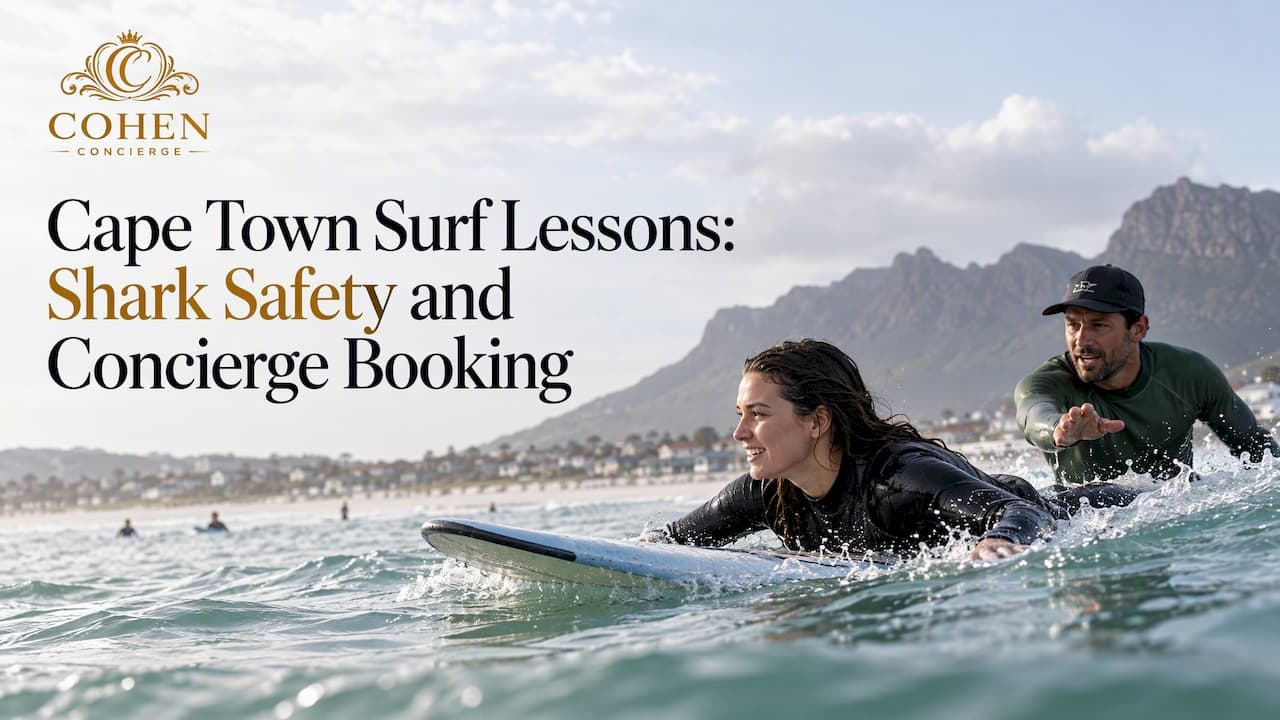
Muizenberg in False Bay is the best place to start, with gentle rolling waves, warmer water and the city's biggest cluster of established surf schools. Book a multi-lesson package or a private lesson for faster progress, since consistent coaching beats a single trial session. If you would rather hand the logistics to someone else, a concierge service can arrange private instructors, transfers and a bespoke surf day around your schedule.
TL;DR:
- Fish Hoek and Melkbosstrand offer quieter beginner alternatives, while Blouberg and Big Bay suit learners who can stand up reliably and read waves.
- A lesson lasts about two hours, but beginners often need three to five sessions with the same instructor to build paddling fitness and wave judgment.
- Choose a beach with active Shark Spotters or lifeguards; leave the water immediately after a siren or black flag, and treat red flags as warnings.
- Summer and early mornings generally bring warmer water, smaller swell, and lighter winds; check the surf report and confirm conditions with the school that morning.
- Check that instructors hold current Surfing South Africa accreditation and first aid or lifeguard qualifications, and confirm class size, equipment, and cancellation terms before paying.
Table of Contents
- Best beginner beaches and where lessons run in Cape Town
- What a surf lesson includes and how to pick the lesson format
- How to choose a good surf school or instructor in Cape Town
- Safety in Cape Town waters: shark spotting, flags and practical precautions
- Best times to book and what conditions suit beginners
- Practical arrival and booking tips: what to bring, arrival time and cost expectations
- Local perspective and concierge advantage
- How long a surf lesson or course actually takes
- Getting to and from surf schools and beaches
- What premium surf schools offer beyond a standard lesson
- What actually matters when you book a surf lesson in Cape Town
- Let us arrange your surf day in Cape Town
- FAQ
- Sources
Best beginner beaches and where lessons run in Cape Town
Where you learn matters almost as much as who teaches you. False Bay and the Atlantic side of the peninsula behave very differently, and beginners do best where the water is forgiving and the swell is small.
Muizenberg sits at the top of most recommendations for good reason: the waves roll in gently over a sandy bottom, the water runs noticeably warmer than the Atlantic side, and the beachfront holds the highest concentration of surf schools in the city, according to a local surf lessons guide. Fish Hoek and Melkbosstrand offer similar conditions on quieter days and suit learners who want fewer people in the water or a change of scenery once they have the basics down.
- Muizenberg: the default first-lesson beach, warm water and a long, gentle break.
- Fish Hoek: a calmer False Bay alternative with fewer crowds.
- Melkbosstrand: a workable option north of the city for mellow, beginner-paced days.
- Blouberg and Big Bay: Atlantic-side spots best saved for progression once you can catch waves confidently, not for a first lesson.
The jump from False Bay to the Atlantic side usually happens once a learner can pop up reliably and read a wave. Colder water, stronger wind and punchier swell at Blouberg and Big Bay reward that extra experience rather than punishing a first attempt, and local guides describe this as the natural progression route for Cape Town surfers.
What a surf lesson includes and how to pick the lesson format
A standard lesson blends a short briefing on the sand with the bulk of the time spent in the water, and most schools bundle in everything you need for a first try.
- Land instruction: a quick safety briefing and pop-up practice on the beach before you touch the water.
- In-water coaching: an instructor pushes you into waves and corrects your technique in real time.
- Equipment hire: a soft-top board and wetsuit are usually included in the lesson price.
- Photo or video add-ons: some schools offer this as an extra, useful if you want to see your own progress.
Group lessons cost less and suit families or friends learning together, but a private lesson gets you more wave time and faster, more specific feedback. Booking a short multi-lesson package rather than a single session tends to produce quicker progress too, since the same coach can build on what you learned the day before instead of starting from scratch, a pattern local instructors and guides both point to.
How to choose a good surf school or instructor in Cape Town
The gap between an average lesson and a genuinely good one usually comes down to who is teaching and how the school runs its operation.
- Check that instructors hold recognised coaching credentials, such as the Surfing South Africa Level 1 course, which covers coaching safety, first aid and best practice.
- Confirm instructors carry a valid first-aid or lifeguard award, a requirement built into the Surfing South Africa accreditation route.
- Ask about class size and the instructor-to-student ratio, particularly for children or nervous first-timers.
- Confirm exactly what is included (board, wetsuit, transport), the cancellation policy and the precise meeting point before you pay.
- Ask whether the school operates on a beach covered by Shark Spotters.
Pro Tip: Ask your school directly whether their coaches hold current Surfing South Africa accreditation rather than assuming every instructor on the beach does.
Safety in Cape Town waters: shark spotting, flags and practical precautions
Cape Town's beaches use one of the more distinctive shark safety systems anywhere, and understanding it makes the water feel far less intimidating.
The Shark Spotters programme stations spotters on mountainsides and beaches above several False Bay beaches, including Muizenberg and Fish Hoek, during set operating hours. Spotters have recorded well over a thousand shark sightings since 2004, a track record that has helped reduce overlap between swimmers, surfers and sharks without harming marine life.
- A siren and a black flag signal a shark sighting: leave the water immediately when you hear it.
- A green flag means low risk conditions and good visibility; a red flag warns of poor visibility or high risk.
- Surf on a beach with active spotters or lifeguards rather than an unpatrolled stretch of coast.
- Stick with your group, avoid solo sessions at dawn or dusk, and follow your instructor's calls without hesitation.
Best times to book and what conditions suit beginners
Timing changes the whole experience for a first-time surfer, and a little planning avoids a cold, choppy, frustrating lesson.
Summer months generally bring smaller swell and warmer water on the False Bay side, which makes for the most forgiving learning conditions of the year. Early mornings tend to be calmer and less windy than afternoons, since the south-easterly wind that Cape Town is known for usually picks up later in the day. Tides and swell size shift daily, so it is worth checking a local surf report and confirming conditions with your chosen school on the morning of your lesson rather than assuming yesterday's waves will repeat.
Practical arrival and booking tips: what to bring, arrival time and cost expectations
A smooth lesson day starts before you reach the beach. Arriving with the right kit and the right expectations saves time and avoids last-minute scrambling.
- Arrive 10 to 15 minutes before your lesson for kit fitting and the safety briefing.
- Bring a swimsuit, a towel, reef-safe sunscreen, water and a change of clothes; most schools offer secure storage, so pack light.
- Carry a card or some cash for extras such as photo packages or an additional hour of board hire.
- Confirm equipment inclusion, group size and the cancellation policy when you book so there are no surprises on the day.
Local perspective and concierge advantage
A locally run concierge service built around Cape Town's lifestyle and event scene, Cohen Concierge specialises in tailored lifestyle management, from airport transfers to private dining and bespoke adventure planning, backed by a network of luxury partners. For readers booking private instructors, coordinating a family group, or wanting transport and dining folded into one surf day, that kind of concierge support can turn several separate bookings into one arranged itinerary.
How long a surf lesson or course actually takes
A single lesson typically runs for around two hours: roughly 20 to 30 minutes of land briefing and pop-up practice, followed by 90 minutes or so in the water working on wave catches and technique. That structure holds fairly consistently across group and private formats, though private lessons sometimes compress the same content into a tighter, more intensive session.

Progress beyond standing up on a wave usually takes several sessions rather than one. Multi-lesson packages, often built around three to five sessions, give an instructor enough time to see the same mistakes repeat and correct them, which is why local guides and instructors alike recommend booking a short course rather than a single try-it lesson if you are serious about learning. A beginner who commits to a package across a week or two tends to leave with real paddling fitness and wave judgement, not just a photo of themselves standing up once.
Plan for the lesson itself plus roughly 30 to 45 minutes either side for arrival, kit fitting and changing afterwards. A half-day is a realistic block to set aside once travel to the beach is factored in, especially from central Cape Town or the Atlantic Seaboard.
Getting to and from surf schools and beaches
Muizenberg sits roughly 25 minutes from central Cape Town by car outside peak traffic, and most surf schools cluster within walking distance of each other along the beachfront, so a single drop-off point usually works for the whole group. Public transport options exist but are limited for visitors unfamiliar with local routes, and carrying a board bag or wet kit on a train is impractical for most first-timers.
Self-driving works for residents who already know the roads, but visitors juggling hire cars, unfamiliar parking and changing traffic patterns often find it adds stress to what should be a relaxed morning. A private transfer solves that directly: a driver who knows the beachfront drop-off points, handles the return trip while you are still sandy and tired, and removes the need to find parking near a busy beach on a summer weekend. For anyone combining a surf lesson with other plans that day, whether that is a winelands trip afterwards or an airport pickup beforehand, a private chauffeur built around your schedule rather than a fixed timetable tends to be the simplest way to string the day together.
What premium surf schools offer beyond a standard lesson
Beyond the standard group or private lesson, some operators offer upgraded experiences aimed at visitors who want more than a basic beach session. VIP-style lessons typically mean a dedicated instructor, a smaller or private group, and more flexible timing around your own schedule rather than a fixed class slot. Luxury gear rental, where available, extends to better-fitted wetsuits and higher-performance boards once a learner has moved past the basics.
These upgrades suit visitors with limited time in Cape Town who want to guarantee a good lesson on a specific day, families who prefer not to share an instructor with strangers, or anyone who wants the logistics handled around a broader day of activities. None of this replaces the fundamentals covered in a standard lesson: solid instruction, the right beach and proper safety awareness matter more than any add-on. But for a visitor stacking a surf lesson alongside dining, transport and other plans in the same day, the premium tier exists specifically to remove friction from that itinerary, bundling instruction with the kind of flexible timing and personal attention that a fixed group class cannot offer.
What actually matters when you book a surf lesson in Cape Town
The conventional advice treats surf lessons in Cape Town like a checklist: pick a beach, pick a school, book a slot. What that advice tends to underweight is consistency. A single try-it lesson is enjoyable but rarely teaches much that sticks, because the two hours get spent just getting comfortable in the water rather than correcting technique.

The stronger approach, and the one the research for this guide kept pointing back to, is to treat your first few sessions as a short course rather than a one-off. Book the same instructor across three or four lessons if the school allows it. Muizenberg's reputation as the easy option is deserved, but it also means it gets busy, so an early morning slot or a quieter weekday session is worth prioritising over whatever time looks convenient on a booking form.
Safety awareness matters more than most first-timers assume going in. Knowing what the flags mean and sticking to a Shark Spotters beach is not an afterthought, it is part of learning to surf properly in this city.
— Jordan
Let us arrange your surf day in Cape Town
Booking a lesson is only one piece of a good surf day. We arrange private instructors, transfers to and from the beach, and the rest of the day around them, whether that is a late breakfast after an early session or a winelands trip once you have rinsed off the sand. Clients use our experiences planning service to combine a surf lesson with dining, transport and anything else on their Cape Town itinerary into one coordinated plan rather than several separate bookings.

| What we arrange | Why it helps your surf day |
|---|---|
| Private instructor bookings | Avoids group scheduling and matches your preferred time |
| Transfers to and from the beach | Removes parking hassle and timing stress |
| Combined itineraries | Links a lesson to dining, wellness or winelands plans |
Reach out to Cohen Concierge to put together a bespoke surf lesson and transfer plan for your time in Cape Town.
FAQ
How many days are required to learn surfing?
Most beginners need several lessons, often booked as a short package of three to five sessions, before they can catch and ride waves with any consistency. A single lesson is enough to stand up once with instructor help, but real progress comes from repeated sessions with the same coach.
Where are some good surfing spots in Cape Town?
Muizenberg is the standard beginner choice thanks to its gentle, rolling waves and warmer water, with Fish Hoek and Melkbosstrand as quieter alternatives. Blouberg and Big Bay on the Atlantic side suit surfers who already have some experience rather than complete beginners.
What is a female surfer called?
A female surfer is simply called a surfer; there is no separate term in common use. Surfing terminology does not distinguish by gender for the sport itself.
What is the 12 second rule in surfing?
This refers to etiquette around wave priority and right of way rather than a single official measured rule, and definitions vary between surf schools and regions. Beginners are generally better off asking their instructor to explain local wave priority and etiquette directly rather than relying on an informal rule.
Sources
- Chapter 17: Shark Safety — City of Cape Town
- SURF COACHING COURSES — Surfing South Africa
- Surf Lessons Cape Town: Your complete guide — Forries