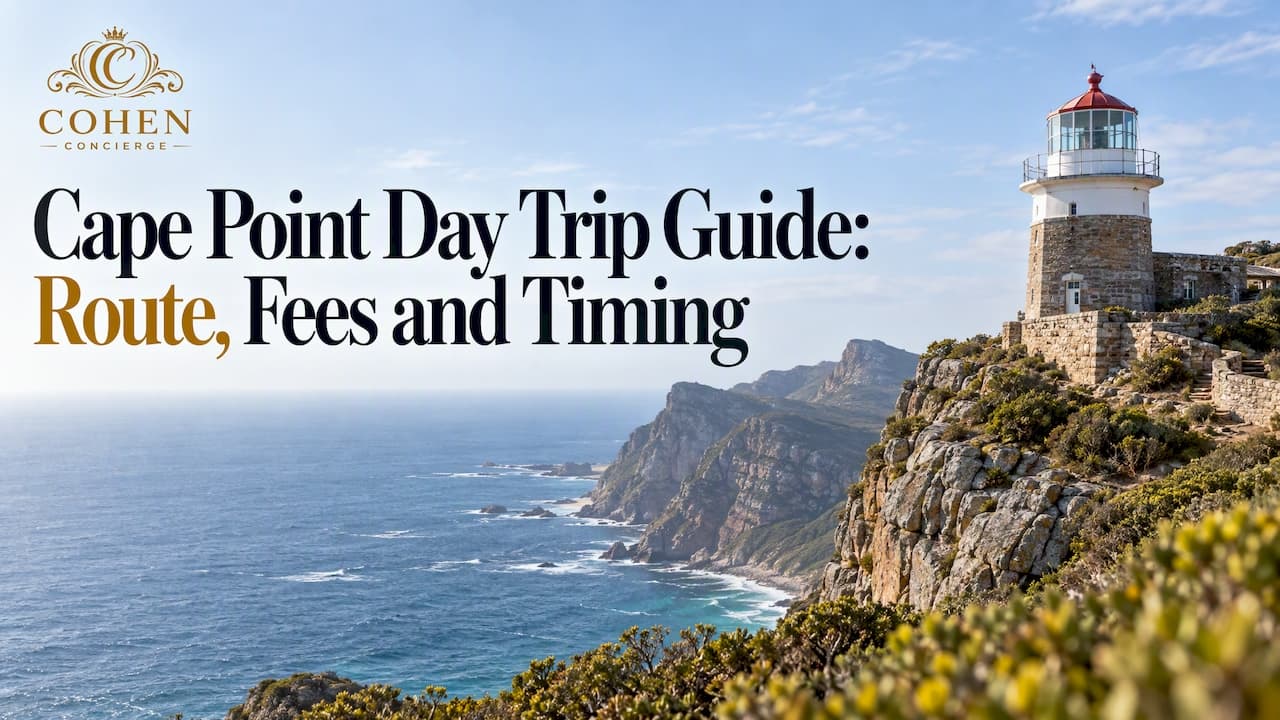
The best Cape Point day trip leaves Cape Town by 08:00, drives the Peninsula clockwise via Chapman's Peak, reaches the reserve before the tour buses, and returns along the False Bay coast. Plan on 9 to 10 hours and roughly 150 km for the full loop, according to The South African Guide. Below you will find the route, current fees, what to do at the Point, how it differs from the Cape of Good Hope, and the mistakes that cost visitors the most time.
TL;DR
- Leave Cape Town by 08:00 and go clockwise: Atlantic coast out, False Bay coast back. Departing after 08:30 means meeting the tour bus traffic.
- Until 31 October 2026, daily conservation fees are R110 for South African adults, R225 for SADC adults and R515 for international adults. Children aged 2 to 11 pay R55, R115 and R250.
- The gate is cash-free. Bring a debit or credit card, plus proof of residency if you are claiming a local rate.
- Cape Point and the Cape of Good Hope are two spots about 2.3 km apart in the same reserve, so you visit both in one entry.
- Baboons are a real risk to your bag and car. Keep windows and doors locked and food out of sight.
Table of Contents
- Cape Point or Cape of Good Hope: which one is it?
- The route: clockwise, leaving by 08:00
- What it costs in 2026
- Opening hours
- What to do at Cape Point
- Baboons: the one rule that matters
- Boulders Beach and the add-ons
- Practical planning
- Self-drive, tour or private driver
- Our perspective
- Having the day arranged
- A sample plan for visitors staying on the Atlantic Seaboard
- FAQ
- Sources
Cape Point or Cape of Good Hope: which one is it?
Both, and you do not need to choose. The Cape of Good Hope lies about 2.3 km west and a little north of Cape Point, inside the same section of Table Mountain National Park. One entry fee covers the whole reserve.
The practical difference is what you do at each:
| Cape Point | Cape of Good Hope | |
|---|---|---|
| What it is | A headland with two lighthouses and a clifftop viewpoint | The rocky, windswept point with the famous signboard |
| Main draw | Funicular or walk to the old lighthouse, views over two oceans | The photo at the sign, coastal walking, wild beaches |
| Time needed | 1.5 to 2 hours with lunch | 30 to 45 minutes |
| Facilities | Restaurant, food shop, retail | Parking and the sign |
There is one persistent myth. Neither is the southernmost tip of Africa. That is Cape Agulhas, roughly 150 km to the east-southeast, as the Peninsula route guide points out. Do not plan Agulhas into the same day.
The route: clockwise, leaving by 08:00
The clockwise loop is the one local guides recommend. Time Out Cape Town advises leaving by 08:00, which puts Chapman's Peak Drive in the morning and finishes on the False Bay coast, away from the worst bus congestion that builds from about 10:00.
A realistic timetable:
- 08:00 Leave the city via the Atlantic seaboard through Camps Bay and Hout Bay.
- 08:45 Chapman's Peak Drive. This is a toll road between Hout Bay and Noordhoek, and it is the scenic highlight of the drive. The operator publishes its current tariffs, so check before you go, as they rise annually. The road can close in bad weather or after rockfalls.
- 09:30 Noordhoek or Kommetjie. A short coffee or beach stop. Do not let it stretch.
- 10:00 to 10:30 Cape Point reserve gate. Aim to be through before the queue builds.
- 10:30 to 13:00 Cape Point and the Cape of Good Hope. Lighthouse, viewpoint, signboard photo, lunch.
- 13:30 to 15:00 Simon's Town and Boulders Beach. The penguin colony sits inside the same national park but has its own gate and fees.
- 15:00 to 17:00 Return through Fish Hoek, Muizenberg and the M3 or the highway.
That is about nine hours before you add any extras. The most common error is underestimating stops: every viewpoint costs 20 minutes, not five.
Why not the other direction?
Driving anticlockwise sends you down the False Bay coast in the morning and into the reserve at peak bus time, then back along Chapman's Peak in the afternoon light with tired passengers. It works, but you queue more and rush the best road. If you must go that way, the only real fix is an earlier start.
What it costs in 2026
The following are the daily conservation fees listed on the SANParks rates page, valid until 31 October 2026:
| Visitor | Adult | Child (2 to 11) |
|---|---|---|
| South African citizen or resident | R110 | R55 |
| SADC national | R225 | R115 |
| International visitor | R515 | R250 |
A new tariff period begins on 1 November 2026, so confirm the figures on SANParks if you travel after that date.
The funicular is charged separately. According to Cape Town Etc, return tickets are R115 for adults and R60 for children and South African pensioners, with one-way fares of R100 and R52. The same report notes that the funicular was closed from 20 July to 31 August 2026 for maintenance, with reopening planned for 1 September. If you travel in a different season, check its status before you build the day around it.
Paying at the gate
The Cape Point and Boulders gates are cash-free: only debit and credit cards are accepted. At Cape Point there is one payment per vehicle, not one per person. Carry your ID or passport with valid permit if you are claiming a South African or SADC rate, because the gate will otherwise default to the international tariff. You can also buy digital tickets in advance through the official SANParks portal to avoid the queue.
If you hold a Wild Card or MyGreen Card, the SANParks cards page explains that these can be used in place of the daily fee.
Opening hours
Hours change with the season. For April to September, Cape Town Etc reports entry from 07:00 to 17:00, with visitors required to leave by sunset. Summer hours are longer, so check the SANParks page for your date. The facilities, including the restaurant and shop, keep their own hours.
What to do at Cape Point
The old lighthouse
The classic move is the Flying Dutchman Funicular up to the old lighthouse. You can also walk the path, which is steep but short. From the top you see the cliffs falling into the sea, and on clear days the meeting of the Atlantic and Indian Oceans is the point of the story, though in practice the water does not show a visible line.
The new lighthouse and the clifftop paths
The newer lighthouse and the paths around it are quieter and give better views than the crowded terrace. Wear shoes with grip. The wind at the top is strong enough to take hats and phones.
Walks and beaches
The reserve has trails across fynbos, down to wild beaches and along shipwreck-strewn coast. Cape Town 101 reminds hikers never to go alone on cliff-top trails and to tell someone their route and expected return time. Weather here can turn from clear to fog and wind within the hour.
Wildlife
Expect baboons, bontebok, eland and ostriches. Treat each as wild. The reserve is a protected area of fynbos, and your fee goes to its conservation and maintenance.
Baboons: the one rule that matters
The Cape Point baboons are habituated to people and will go for bags, cars and food. SANParks advises keeping vehicle windows and doors locked at all times, even when parked, and never leaving food visible or unattended, because they can break into vehicles. Eat at the restaurant or inside a closed car, never at a picnic spot with a bag on the ground. Do not feed them: it is dangerous for you and ends badly for the animal.

Boulders Beach and the add-ons
Boulders is the usual afternoon add-on, and it is worth it for the African penguin colony. It has its own gate and, like Cape Point, takes cards only. Keep to the boardwalks and give the birds space.
Other stops that fit the route without wrecking the schedule:
- Hout Bay or Noordhoek: a quick coffee, or a longer lunch if you skip the Cape Point restaurant.
- Kalk Bay: harbour, galleries and fresh fish on the way back.
- Muizenberg: the colourful beach huts, if you still have an hour.
Adding a winelands detour is a different day. If wine is the priority, treat it as a separate trip, such as a Cape Winelands experience.
Practical planning
Weather. The Peninsula's wind and fog can change a plan fast. Keep flexibility in the itinerary, bring a windproof layer even in summer, and be ready to swap stops if the cloud sits on the Point.
Phone signal and data. Coverage can be patchy on the Atlantic side and in the reserve, and you will want maps, tickets and your card app. If you are visiting from abroad, a South African eSIM installed before you land saves you hunting for a SIM at the airport. Download offline maps as well.
What to pack. Sunscreen, water, a windbreaker, closed shoes, a card for the gate, and proof of residency if relevant. Leave nothing edible visible in the car.
Driving. Roads are good, but weekend and holiday traffic on the way back can add an hour. If you are tired from travel, a chauffeur removes the parking, toll and navigation work from the day.
Self-drive, tour or private driver
There are three sensible ways to do the day. None is right for everyone.
| Option | Best for | Trade-off |
|---|---|---|
| Self-drive | Confident drivers, flexible timing | You handle parking, tolls, navigation and baboon-proofing |
| Group tour | Solo travellers on a budget | Fixed stops, bus timing, you arrive when everyone else does |
| Private driver or arranged day | Families, groups, short stays, special occasions | Costs more, but you set the pace and the start time |
The group bus timing is the real issue. The very thing that makes Cape Point crowded is the same schedule that group tours follow, so a private start at 07:30 can put you at the Point before most of them arrive.
Our perspective
We arrange this day for visitors and for Cape Town residents hosting guests, and the pattern is consistent: the trip is good or bad depending on the first 90 minutes. Leave early, and the whole Peninsula opens up. Leave at 09:30, and you spend the day in other people's brake lights.

Our advice is to build the day around one or two anchor moments rather than stuffing in everything. Chapman's Peak in the morning light, an unhurried hour at the lighthouse, and lunch somewhere you chose rather than somewhere that had parking. Skip anything that makes you rush.
We also think the day goes best when the logistics vanish: a driver who knows when each stop is busy, a lunch table already held, a plan B if the fog comes in. That is what discreet, fast-response concierge work is for, and it is why guests who book it tend to remember the views rather than the traffic.
— Jordan
Having the day arranged
If you would rather not manage the driving, the timing and the bookings, we arrange a privately planned Cape Point route around your group, whether that is a family, a honeymoon or a business visit. We can pair it with a private chauffeur, book a restaurant for lunch or dinner, or have a private chef waiting at your villa after the long day. Pricing is arranged per request, so tell us what you have in mind and we will come back to you.
A sample plan for visitors staying on the Atlantic Seaboard
If you are based in Camps Bay, Clifton or Bantry Bay, the clockwise loop is easy because you are already on the right side of the mountain. Leave at 07:45, pass through Llandudno and Hout Bay, and be on Chapman's Peak well before the tour traffic. If you stay in the city bowl or the Waterfront, add 15 to 20 minutes.
For a family with young children, split the day: Chapman's Peak and the reserve in the morning, an early lunch, and Boulders in the afternoon only if everyone has energy. Penguins do not require a perfect timetable, but toddlers do.
For a group celebrating, a long lunch in Kalk Bay or Simon's Town on the return leg often makes a better finish than a rushed sunset stop at the Point.
FAQ
How long does a Cape Point day trip take?
Plan on 9 to 10 hours for the full Peninsula loop, covering about 150 km from the Cape Town city centre, according to The South African Guide. If you only drive straight to the reserve and back, you can do it in a shorter half day. Add time for Boulders Beach and lunch.
How much is Cape Point?
Until 31 October 2026, the daily conservation fee is R110 for South African adults, R225 for SADC adults and R515 for international adults, with lower child rates. The funicular is extra. Always check SANParks for the tariff that applies on your date.
Is Cape Point worth it?
Yes, if you go early and treat it as a day out in a nature reserve rather than a quick photo stop. The scenery on the way, particularly Chapman's Peak, is half the value. It is less rewarding if you arrive at midday in fog with a tight schedule.
Is the Cape of Good Hope the same as Cape Point?
No. They are separate points about 2.3 km apart, both inside the same reserve, so one entry covers both. Cape Point has the lighthouses and funicular, while the Cape of Good Hope has the famous signboard.
Sources
- Cape Peninsula Day Trip Route, The South African Guide
- Rates & Entry Fees, SANParks
- Table Mountain National Park goes cash-free, SANParks
- Access Cards, Activity Permits & Wild Cards, SANParks
- Cape of Good Hope and Cape Point, SANParks
- The ultimate guide to exploring Cape Point, Time Out Cape Town
- Cape Point entrance fees 2026, Cape Town Etc
- Cape Point Nature Reserve, Cape Town 101
- Cape of Good Hope, Wikipedia
- Standard Tariffs, Chapman's Peak Drive