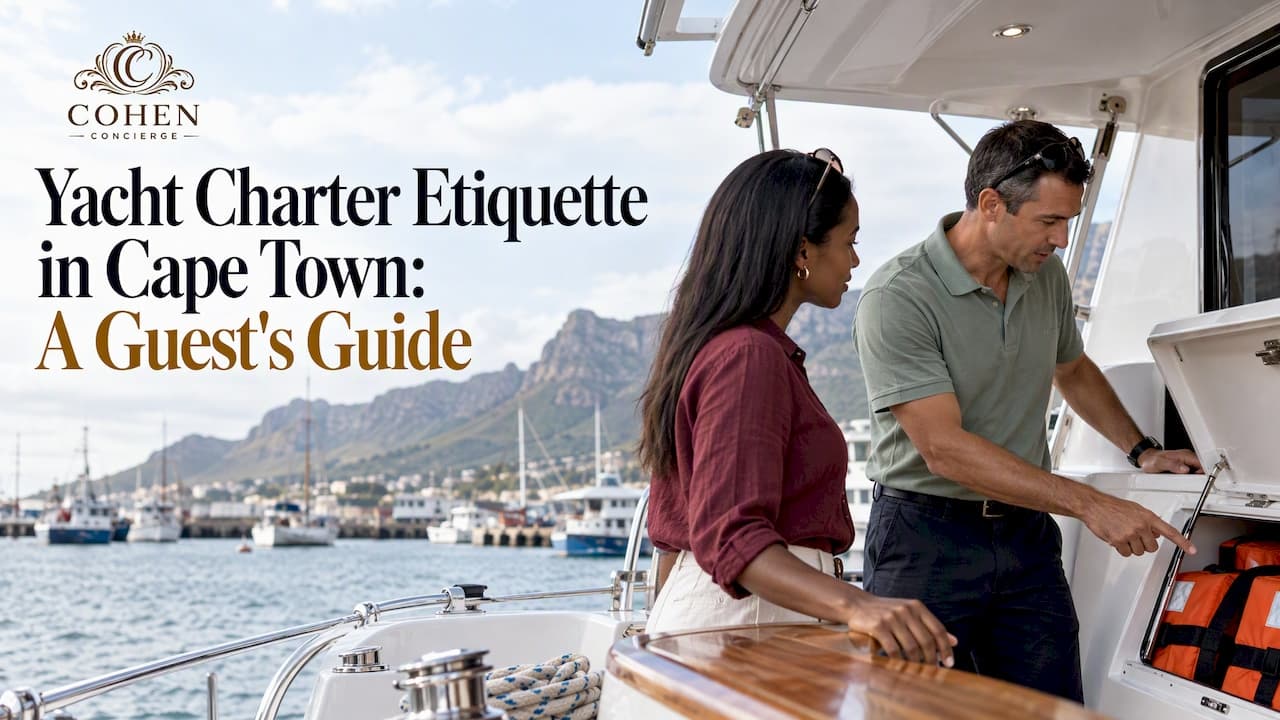
Good yacht charter etiquette comes down to a few habits: treat the boat as if it were your own, listen to the safety briefing, take your shoes off, respect the crew's space, accept the captain's decision on weather, and settle the gratuity privately at the end. Get those right and the day runs smoothly for everyone. Below we cover what is expected on a Cape Town charter, from the V&A Waterfront to the Atlantic Seaboard, and what the rules look like when you are not sure.
TL;DR
- Tip the whole crew through the captain, on the last morning. Industry guidance quotes 5% to 15% of the charter fee, depending on how pleased you were.
- Attend the safety briefing, wear a life jacket when asked, and never exceed the passenger number on the vessel's safety certificate.
- Go barefoot or in soft-soled deck shoes, bring soft luggage, and keep music and voices at a sensible level.
- The captain has the final say on wind, swell and route. Cape Town weather changes quickly, so keep your plans flexible.
- Crew areas are private, and a skipper is not a cook, cleaner or childminder unless the booking says so.
Table of Contents
- Why etiquette matters more on a yacht than on land
- Before you board
- Safety: the part that is not optional
- Life on board: how to be a good guest
- Tipping: how much, and how to give it
- Etiquette for groups, families and celebrations
- What we think about guest etiquette
- Arranging a charter with Cohen Concierge
- A short checklist for the day
- FAQ
- Sources
Why etiquette matters more on a yacht than on land
A yacht is someone's property, a workplace and a safety-critical vessel all at once. The crew live and work in a very small space, and they are responsible for everyone on board. Most of the "unwritten rules" exist for that reason: they protect the boat, the people and the mood.
Cape Town adds its own factors. The water is cold, the wind can arrive suddenly, and marinas and anchorages are busy. One local charter guide advises guests to rely on the crew's knowledge of sudden wind, currents and reefs and to keep flexibility in their plans. That is etiquette and common sense in the same sentence.
Before you board
Pack for the boat, not the hotel
The customary rule on a charter yacht is barefoot, with shoes removed once you step aboard. High heels and black soles can damage or mark teak decks, so bring clean, white or non-marking soft-soled deck shoes if you want footwear for the quay or for cooler evenings.
The same source recommends soft luggage. Hard-sided suitcases are difficult to stow and can damage cabinetry. A soft holdall, a layer for the wind, sun protection and a swimsuit will cover most Cape Town days. Leave anything valuable or fragile at your villa or hotel unless you need it.

Tell the crew what matters
Share dietary needs, allergies, anyone who cannot swim, and any mobility concerns before the day, not after the lines are cast. The crew plan provisioning and the deck layout around this. If you are booking through us, we pass those details on in advance so the captain is not hearing them for the first time at the dock.
Be on time and keep the group to the booked number
A late arrival can shorten your day, and tides, wind and port traffic rarely wait. Just as important, never bring extra guests. Vessels are certified for a set number of people, and South African maritime safety guidance states plainly that you must not exceed the number of people on the safety certificate. A friend who "will just squeeze in" is a safety problem, not a favour.
Safety: the part that is not optional
The briefing
Before every departure you should be shown where the safety equipment is and how it works. SAMSA's guidance requires this. One leading brokerage notes that the initial safety briefing is mandatory and guests should ask if anything is unclear. Put your phone away, listen, and ask questions. Nobody on the crew will think less of you for asking where the life jackets are.
Life jackets
The same SAMSA guidance says life jackets must be worn by children under 12 on deck while underway, whenever the skipper directs, and by everyone in rough conditions. Local charter operators also note that commercial charters carry life jackets, the crew may require them in rough seas, and young children should wear them throughout the trip. If you are asked to put one on, do it without debate. Cape Town's water is cold enough to make a fall overboard serious even close to shore.
Who is in charge
The captain's decision is final on safety and weather. Boat International's etiquette guide is clear that guests should not argue when the captain changes or cancels plans. In Cape Town this can mean shortening a sunset cruise, moving to a more sheltered stretch of coast, or staying in the harbour altogether when the south-easterly is blowing hard.
The graceful response is a plan B. Ask the captain what is possible instead, whether a different time of day would be calmer, and whether the day can be rescheduled. If you want help judging what suits your group, our guide to boat trips in Cape Town and the safety checks worth making covers durations from 30 minutes to half a day.

What regulated operators should be able to show
Owners and operators of commercial charter vessels work within a regulatory framework: SAMSA sets out requirements for sail and motor yachts over 25 GT and under 100 GT used for commercial charter with no more than 12 passengers. Its checklist also says safety equipment must be inspected and ready for use, and that commercial skippers must practise emergency procedures at least weekly. If you are curious about how vessel status and compliance work behind the scenes, this overview of charter yacht coding rules is a good place to start. As a guest, the practical point is simple: a properly run charter is happy to talk about its safety setup, and you should never feel awkward asking.
Life on board: how to be a good guest
Treat the yacht as your own
This is the first rule on almost every list. Keep the boat tidy, put rubbish in the bins, handle furniture and equipment carefully, and follow crew instructions. Local operators say the same thing in plain words: treat the yacht as your own and treat the crew with courtesy.
Some practical examples:
- Rinse sand and salt off your feet before going below.
- Use towels provided for the beach or swim deck, not the ones from your cabin bathroom.
- Keep wet swimwear off upholstery.
- Drinks go on coasters or in the holders provided, particularly on varnished surfaces.
- Ask before using water toys, tenders or paddleboards. The crew need to supervise and check conditions first.
Noise
Sound travels very far over water. Cape Town's guidance is to keep music and voices at a reasonable level, because noise carries in marinas and at anchor. Celebrations are welcome, and a birthday on deck is part of the point of a charter, but agree the sound plan with the captain and turn it down when you are close to other boats or moored overnight.
Smoking
Smoking is prohibited in cabins and staterooms for safety reasons, and some yachts allow it only in designated outdoor areas. Ask before you light up, and never discard anything over the side.
Crew space and boundaries
Crew-only areas are private. Do not enter them without an invitation, and do not assume that a friendly atmosphere means the crew want to socialise late into the night. Another brokerage reminds guests to allow crew time and space to work, avoid keeping them awake until sunrise, and respect their privacy.
A few small courtesies go a long way: learn names, say thank you, mention it if something is wrong rather than letting it sit, and tell the crew when you want to be left alone or when you would like the evening to end.
Know what a skipper does, and does not, do
On a skippered bareboat-style charter the arrangement is different from a fully crewed luxury yacht. One South African operator explains that a skipper handles navigation, weather monitoring, safety, dinghy transport, maintenance and the safety briefing, and that guests should provide the skipper with a cabin and food and drink. The same page says skippers are not responsible for cooking, cleaning for the group, emptying guests' bins, childcare or organising excursions. Check your booking so you do not expect services that are not included.
Tipping: how much, and how to give it
Tipping is the question guests ask most, and it is also the area where advice varies. Gratuity is discretionary, but customary for good service.
| Source | Guidance |
|---|---|
| MYBA guidance, as reported by Boat International | 5% to 15% of the charter fee, depending on satisfaction |
| A yacht charter operator's FAQ | Commonly around 10% of the charter fee |
Some websites quote 15% to 20%, and others suggest lower figures for other countries, so treat any single number with care. The two sources above give a sensible range to work within.
A simple method
- Decide on the figure privately. Start from the charter fee, not the cost of extras, and adjust for how well the day went.
- Raise it with the captain on the last morning. That is the usual moment, not at the start and not scattered through the trip.
- Give it to the whole crew, not to individuals. Boat International's advice is that a pooled payment is fairer because every department contributes, including people you may rarely see, such as the person who prepared the boat before you arrived.
- Ask the captain to distribute it. The operator above also says the gratuity should be entrusted to the captain for fair distribution.
For a short half-day charter, ask the operator what is usual on that boat. If something went wrong because of the weather rather than the crew, that is not a reason to tip less. If the crew changed plans to keep you safe, that is the job done well.
Etiquette for groups, families and celebrations
The biggest charters in Cape Town tend to be celebrations: birthdays, honeymoons, corporate hospitality and family holidays. The same rules apply, and a few extra points help.
- Name one point of contact. The captain should hear instructions from one person, not six.
- Keep an eye on alcohol. Decks move, and a boat is not a place to lose your balance. Watch swimming after drinks in particular.
- Supervise children. The crew are not childminders, and young children should wear life jackets throughout the trip.
- Agree the schedule. If dinner ashore follows the cruise, tell the captain so the timing works for them as well as you.
- Think about guests with seasickness. Tell the crew early. Fresh air, a view of the horizon and an upwind seat help more than a stern apology.
If your day combines a cruise with dinner, a sunset stop or a beach club, we plan them as one itinerary. Our Clifton to Camps Bay concierge itinerary shows how we pace a day on the Atlantic Seaboard, and our restaurant reservations service takes care of the table afterwards.
What we think about guest etiquette
We arrange yacht charters in Cape Town, and our view is straightforward: etiquette should never feel like a rulebook handed to you at the quay. It is what makes the day feel effortless. A guest who knows the basics, and whose host has explained the rest in advance, can enjoy the water rather than worry about it.
Our approach is built around discretion and a fast response. We would rather answer your questions the week before than have you wondering on the dock. Tell us the size of the group, the occasion, who is nervous about the sea and what you want the day to feel like, and we match that to the boat and crew through our network of luxury partners. We also tell you plainly what to expect: what is included, who is on board, how gratuity is usually handled and what happens if the wind decides otherwise.
The most common mistake we see is not bad manners. It is assuming. Guests assume the boat can go anywhere, that a skipper also serves lunch, or that the weather will behave. A short conversation beforehand removes nearly all of it.
— Jordan
Arranging a charter with Cohen Concierge
If you would rather not manage the details yourself, our concierge team arranges yacht charters in Cape Town end to end: finding the right vessel for your group, briefing you on what to expect, coordinating transfers to the marina and timing the rest of your day around the water.

We do not publish fixed prices, because each charter is tailored. Tell us your dates, group and preferences through our concierge request page, and we will come back to you with options. If you also need a driver for the day, we can arrange a private chauffeur, or a private chef at your villa for the evening afterwards.
A short checklist for the day
- Confirm the meeting point, time and the number of guests with the operator.
- Pack soft luggage, non-marking deck shoes, sun protection and a warm layer.
- Pass on allergies, medical needs and swimming ability beforehand.
- Attend the safety briefing and ask about anything unclear.
- Wear a life jacket when asked, and make sure children wear theirs.
- Ask before using water toys, the galley or the tender.
- Keep noise reasonable and smoke only where permitted.
- Respect crew areas and crew rest.
- Accept the captain's weather call and talk through alternatives.
- Discuss gratuity privately with the captain on the last morning.
FAQ
What is a good tip for a yacht charter?
Guidance quoted by Boat International from MYBA is 5% to 15% of the charter fee, depending on satisfaction, while another operator suggests around 10%. Settle it privately with the captain on the last morning and give it to the whole crew rather than to individuals.
What is the number one unspoken rule on a boat?
On a charter it is to treat the vessel and the crew as you would treat someone's home and workplace. That means taking your shoes off, keeping things tidy and following instructions, especially from the captain. Etiquette guides for ramps and waterways have their own first rule about preparing before you launch, but for guests the equivalent is simply to be ready and listen.
Do I have to wear a life jacket on a Cape Town charter?
South African maritime safety guidance says children under 12 must wear one on deck while underway, and everyone must wear one when the skipper directs or in rough conditions. Commercial charters carry life jackets for this reason. Follow the crew's instruction without question, and ask at the briefing if you are unsure where they are kept.
Can I argue if the captain cancels or changes the trip because of weather?
No, the captain's decision on safety and weather is final. Cape Town wind and swell can change quickly, so the better approach is to ask about alternatives such as a sheltered route, a different time or a reschedule. Building some flexibility into your plans at the booking stage makes this much easier.
Sources
- Charter yacht etiquette: 24 tips every luxury guest should know, Boat International
- Frequently Asked Questions, Yacht Charter, Bluewater
- Charter etiquette: how to be a good guest, Burgess
- Yachting in Cape Town: Everything You Need to Know
- Skippered Sailing Vacations FAQs, Sunsail South Africa
- South African Maritime Safety Authority, safety guidance for small vessels
- South African Maritime Safety Authority, notice on commercial charter yachts