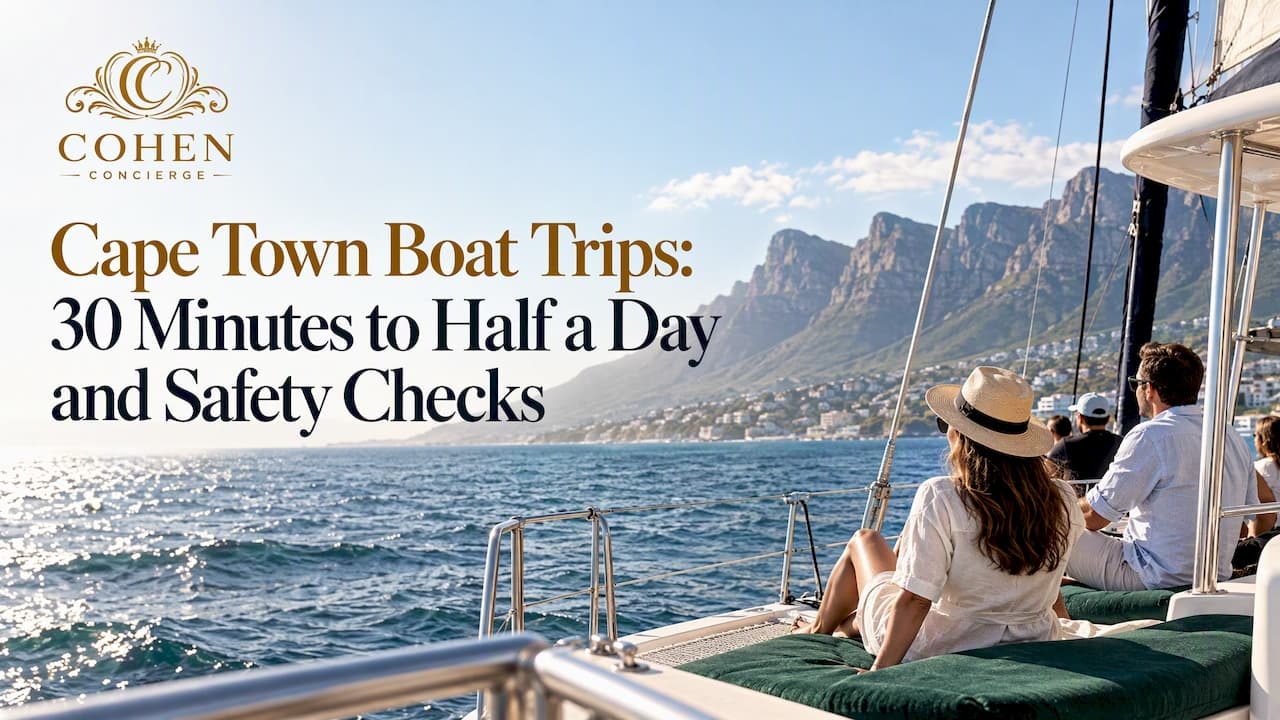
The best boat trips in Cape Town fall into a handful of types that cover almost every traveller: sunset champagne cruises for romance, catamaran coastal cruises and harbour sightseeing trips for families, seal and whale-watching excursions for wildlife lovers, and private yacht charters for anyone wanting a bespoke day on the water. These work well because they match the Cape's calmer sailing months and its SAMSA safety standards, giving you a clear, low-risk way to choose.
TL;DR:
- Choose February to April for calmer seas and warmer water; for whales, travel June through November, especially July through September.
- Harbour trips run about 30 minutes, coastal catamarans about 60, and sunset cruises about 90; canal rides suit travelers sensitive to motion.
- Before booking, confirm the vessel has a current SAMSA safety certificate, enough life jackets, matching passenger capacity, and a clear weather cancellation policy.
- During December and January, book early and favor morning departures; boats fill quickly, while private charters need extra lead time and a written itinerary.
Table of Contents
- 1. What are the main boat trip types and what should you expect?
- 2. When is the best time for a Cape Town boat trip?
- 3. Safety, regulation and what to check before you book
- 4. How do you choose the right trip and book with confidence?
- 5. Sample itineraries for different types of traveller
- 6. A local perspective on planning a Cape Town boat day
- 7. How we can arrange your Cape Town boat trip
- FAQ
- Sources
1. What are the main boat trip types and what should you expect?
Cape Town's working harbour at the V&A Waterfront is the starting point for most trips, with Hout Bay serving as the departure point for seal-viewing excursions. Knowing what each trip actually involves, rather than just its name, makes the choice far easier.
Harbour sightseeing boats from the V&A tend to run around 30 minutes and stick to sheltered water, which makes them the gentlest introduction to being on the water. You will see the working harbour, Table Mountain from the water and, depending on the route, the breakwater and nearby coastline. These are usually shared trips, often with a small onboard bar, and they suit families with young children, first-time boat passengers or anyone prone to motion sickness who still wants a taste of the sea.
Catamaran coastal cruises step things up to around 60 minutes and head further along the Atlantic seaboard, giving you views of Clifton, Camps Bay and the Twelve Apostles mountain range from offshore. Catamarans are stable by design, so the motion is mild even when there is some swell, and most run as shared trips with space to move around the deck. They suit couples, photographers and travellers who want scenery without committing to a full day.
Sunset champagne cruises, often the 90-minute version of the coastal catamaran format, time their departure to catch the light over the Atlantic and typically include a drink and sometimes canapés as part of the ticket. These are the trips most associated with proposals, anniversaries and date nights, and they work well for couples precisely because the timing and the drink are built in rather than improvised.
Seal-viewing launches from Hout Bay head out to Seal (Duiker) Island, a short round trip, with the boat idling near the colony so passengers can watch and photograph the seals at close range. Expect a slightly livelier ride than the sheltered harbour trips since you are briefly in open water, and a stronger smell near the island itself. These suit wildlife-focused travellers and families with older children who will appreciate the spectacle.

Whale-watching trips run longer, often half-day charters, because sightings depend on patience and covering more coastline. Expect more pronounced motion than the sheltered trips, binoculars rather than champagne, and a guide pointing out breaching or spouting whales when conditions allow. These suit nature enthusiasts and anyone visiting during the cold-water season when whales are reliably present offshore.
Private yacht charters for bespoke routes let you set the itinerary, duration and pace yourself, whether that is a half-day loop past the Twelve Apostles or a full-day run towards Cape Point. These are private by definition, which means no fixed schedule and the flexibility to add catering, music or a particular route, making them the natural choice for luxury seekers, special occasions or larger groups who want the boat to themselves.
Canal and electric boat rides are the newest addition to the harbour scene: a quiet, low-wash alternative that loops through the Waterfront's canal system rather than out to open water. Cape Town's first commercial electric boat seats 32 passengers and runs short, calm loops, making it a strong pick for travellers with limited mobility, very young children or anyone who wants the harbour experience without any open-water motion at all.
Shark-access excursions, typically run from further along the coast rather than directly from the V&A, combine a boat trip with a viewing or cage-diving component and run as half-day outings given the travel and setup involved. These suit adventure seekers specifically rather than general sightseers, and they carry the most intense experience on this list.
A few practical notes apply across the board:
- Boarding points cluster around the V&A Waterfront for harbour, coastal and sunset trips, and Hout Bay for seal-viewing.
- Shared trips (harbour, coastal, sunset, seal-viewing) suit solo travellers and couples on a budget; private charters suit groups wanting exclusivity.
- Food and drink are commonly included on sunset cruises and charters, less often on short harbour or canal rides.
- Accessibility varies by vessel: electric canal boats and larger catamarans tend to be the easiest for travellers with mobility needs.
2. When is the best time for a Cape Town boat trip?
Timing changes the experience more than almost any other factor in Cape Town, largely because of the wind. The south-easterly "Cape Doctor" is a defining feature of the local climate, and avoiding its strongest spells makes the difference between a smooth outing and a bumpy one.
February to April is widely regarded as the sweet spot for Cape Town boating, according to local operator guidance, because the south-easter eases off and the Atlantic water is at its warmest for the year. This window tends to deliver calmer seas, better visibility and more comfortable conditions on deck, which matters most for coastal catamaran cruises and sunset trips that spend real time in open water.
Whale-watching follows an entirely different calendar. Whale season runs from June through November on the Western Cape coast, with the highest concentration of southern right whales typically recorded between July and September. If a sighting is the priority, winter and early spring beat the warmer months, even though the sea itself is choppier and colder at that time of year. Our piece on Hermanus whale season covers the specific late-September window in more detail for travellers planning around that peak.
The Cape Doctor is strongest in mid-summer, particularly December and January, which is also the busiest tourist season. Mornings tend to stay calmer even in windier months, so booking an early departure in December or January often gives a smoother ride than an afternoon slot on the same day. December and January are also when boats fill up fastest, so booking ahead matters more than at any other time of year.
For most first-time visitors choosing between a sunset cruise, a coastal catamaran and a whale-watching trip, the practical rule is simple: pick February to April for comfort, June to November for whales, and book mornings whenever you are travelling in the windier summer peak.

3. Safety, regulation and what to check before you book
Every commercial passenger vessel operating in South African waters needs a valid Local General Safety Certificate, known as an LGSC, issued and surveyed by the South African Maritime Safety Authority. These certificates are not a one-off formality: they are surveyed and operators should check that the paperwork is current, which means an operator carrying current paperwork has had their vessel independently checked recently.
Operational category also matters. Vessels licensed under Category R rules for sheltered waters are restricted to calmer, enclosed areas such as the harbour, and some are exempt from carrying a liferaft when operating within a port breakwater. A boat licensed for open water, by contrast, carries different safety equipment and faces different limits, which is part of why a 30-minute harbour cruise and a half-day whale-watching trip look so different on the water.
Skippers and owners also carry reporting responsibilities. Under the Merchant Shipping regulations governing small vessels, owners must leave voyage particulars, including the vessel's identity, who is aboard, the intended route and expected times, before heading out, and comply with harbour reporting mechanisms where they apply. This is the paper trail that lets search and rescue respond quickly if something goes wrong.
Before paying for any trip, a short checklist protects you:
- Ask the operator to confirm their LGSC is current and covers the vessel you will board.
- Check the stated passenger capacity matches what you are told on the day.
- Confirm life jackets are available for every passenger, including children.
- Ask about the weather and cancellation policy before you commit to a time slot.
- For open-water trips, ask whether a liferaft is carried, since this depends on the vessel's licensed area.
Pro tip: Ask the operator for the vessel's approximate area of operation and how they handle voyage reporting. A clear, confident answer is usually a good sign that the skipper and owner take their responsibilities seriously.
4. How do you choose the right trip and book with confidence?
Once you know the trip types and the safety basics, choosing the right one comes down to a short set of questions about your own trip rather than the boat itself.
Start with a simple checklist: How many people are travelling, and do you want a shared or private boat? Does anyone have mobility needs or a low tolerance for motion, which would point towards harbour or canal trips over open-water ones? Is wildlife the priority, which pushes you towards seal-viewing or whale season, or is scenery and atmosphere enough? Finally, do you want a fixed time slot or a half-day with flexibility, and does morning or afternoon suit your schedule better given the wind patterns already covered?
Once you have a shortlist, a short set of questions to any operator before booking will tell you most of what you need to know:
- Can you confirm your LGSC is current and valid for this vessel?
- What is your cancellation or rescheduling policy if the weather turns?
- Where exactly is the departure point, and how far in advance should we arrive?
- What onboard facilities are included: toilet, shade, food and drink?
- What qualifications does the skipper hold, and will there be a safety briefing before departure?
Prices vary by trip type and length rather than following a single formula, so it helps to think in bands rather than fixed figures. Short shared harbour or canal trips sit at the more affordable end. Coastal catamaran cruises and sunset champagne cruises cost more given their longer duration and included drinks. Seal-viewing and whale-watching trips, run as half-day outings, sit higher again. Private yacht charters are priced individually since you are paying for the whole boat and a tailored route, and operators typically quote once they know your group size, duration and preferred itinerary. Peak season, particularly December and January, tends to carry a premium across all categories, while morning departures in windier months often cost the same as afternoon slots but deliver a noticeably smoother ride.
Pro tip: For time-sensitive dates such as Christmas week or the summer school holidays, book well ahead. If you are arranging a private charter, allow more lead time still and ask for a written itinerary confirming route, duration and inclusions before you pay.
5. Sample itineraries for different types of traveller
Pairing a boat trip with the right activity either side turns a single booking into a proper day out. A few combinations work particularly well for the traveller types most people fall into.
- Romantic: a sunset champagne cruise from the V&A Waterfront, timed to catch the light, followed by a dinner reservation at a nearby waterfront restaurant. Keep the motion note in mind: a 90-minute coastal cruise has mild swell, so this pairs best with travellers who are reasonably comfortable on water.
- Family half-day: a harbour sightseeing cruise in the morning, when conditions are calmest, followed by a visit to the Two Oceans Aquarium a short walk from the same harbour. This keeps the day low-motion and easy for younger children.
- Wildlife-focused: a whale-watching trip during the June to November season, paired with a scenic coastal drive afterwards to extend the day. Expect more pronounced motion than the sheltered trips, so this suits travellers without serious motion sensitivity.
- Luxury or special occasion: a private yacht charter along the Atlantic seaboard, paired with a transfer out to the Cape Winelands the following day for a contrasting, land-based luxury experience.
- Adventure seeker: a seal-viewing launch from Hout Bay in the morning, when the water tends to be calmer, combined with a drive out towards the Cape Point route in the afternoon for a full day centred on the coastline.
Each of these can be adjusted for accessibility or seasickness concerns: swap a coastal or wildlife trip for the gentler harbour or canal option if motion is a worry, and favour morning departures year-round if you want the calmest possible water. For travellers who would rather not coordinate transfers, restaurant bookings and timing windows themselves, arranging these details privately is a straightforward way to turn a list of good ideas into a day that actually runs on schedule.
6. A local perspective on planning a Cape Town boat day
Working with clients who want a boat trip arranged rather than booked blind, the same questions come up again and again: which month avoids the wind, whether a private charter is worth it for a two-person celebration, and how to get from a Camps Bay villa to a Hout Bay departure point without losing half the morning to traffic.
The wind is the detail most visitors underestimate. A trip booked for a Tuesday afternoon in July can feel completely different from the same trip in the morning, and that single scheduling choice matters more than which operator you pick. We regularly build transfers around the calmer morning window rather than the time a client first requests, simply because it makes the trip itself better.
The other recurring request is onboard touches for an occasion: a bottle chilled and waiting, a small celebration arranged without the client having to call ahead themselves. None of this changes the boat trip itself, but it removes the logistics that otherwise eat into the day.
— Jordan
7. How we can arrange your Cape Town boat trip
We handle the parts of a boat trip that are easy to get wrong from abroad: timing a departure around the wind, getting you from a villa to Hout Bay or the V&A Waterfront on schedule, and arranging a private charter with onboard catering when a shared trip will not do. Our network of local partners helps us coordinate requests around calm morning windows.

Clients most often ask us to:
- Book a private transfer timed to a specific departure window.
- Coordinate a yacht charter's timing around the calmest sailing conditions.
- Arrange onboard catering or celebration extras for an anniversary or proposal.
If you would rather hand over the logistics than manage them yourself, our yacht charter service is the most direct way to get a bespoke day on the water arranged end to end.
FAQ
What is the best boat tour to take in Cape Town?
There is no single best tour since it depends on what you want: a sunset champagne cruise suits couples, a harbour sightseeing cruise suits families, and a whale-watching trip suits wildlife enthusiasts visiting during the June to November season. Matching the trip to your group and priorities matters more than chasing a single "best" option.
What are good boat tour packages for a Cape Town visit?
Most visitors do well combining a short harbour or coastal catamaran cruise with one longer outing, such as a seal-viewing trip from Hout Bay or a half-day whale-watching excursion in season. Pairing a boat trip with a land-based activity, like a Winelands transfer or a coastal drive, rounds out a full day without overloading it.
What are the top boat-based activities among Cape Town's attractions?
Boat-based options sit alongside Cape Town's major sights and typically include harbour sightseeing cruises, sunset champagne cruises, seal-viewing launches to Duiker Island, and whale-watching trips during the southern right whale season. Private yacht charters offer a flexible alternative for travellers who want a tailored route rather than a fixed schedule.
When is the calmest time to take a boat trip in Cape Town?
Local guidance points to February to April as the calmest, warmest window, since the south-easterly Cape Doctor eases off during these months. In windier months, morning departures are usually calmer than afternoon ones regardless of the season.
How do I check that a Cape Town boat operator is safe to book with?
Ask the operator to confirm they hold a current Local General Safety Certificate issued by SAMSA, which is surveyed and renewed every 12 months. It is also worth confirming lifejacket availability and the vessel's weather or cancellation policy before you pay.
Sources
- Maritime Safety Authority
- South Africa’s First Commercial Electric Boat launches at Cape Town’s V&A Waterfront - Cape Town Tourism
- The best time for a boat trip in Cape Town · El Capitan Marine
- The best time to visit Cape Town for whale watching, wildflowers and wineries - Lonely Planet