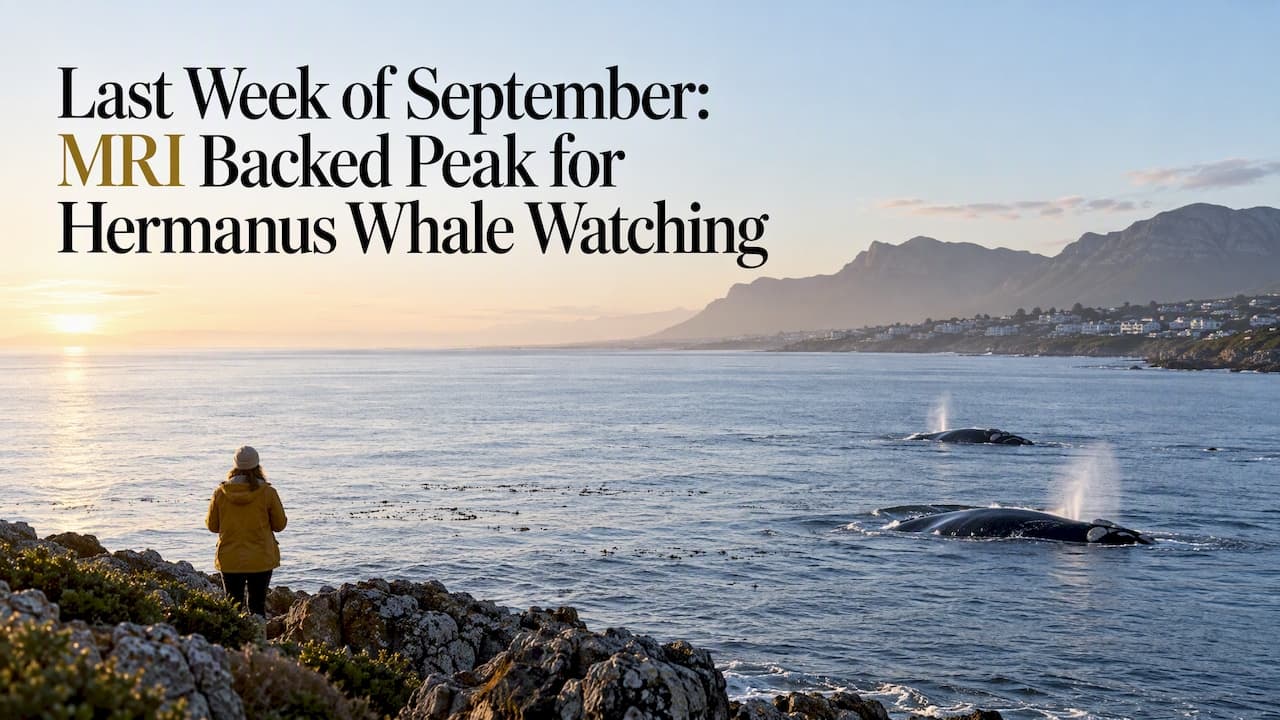
The best time for whale watching in Hermanus is during the season running from June to November, with the single highest-probability week being the last week of September, when the Mammal Research Institute's annual aerial survey targets peak cow-calf density. Plan for an early morning viewing on the cliff path, and book well ahead since weather and crowds both shift fast.
TL;DR:
- The peak cow-calf density occurs during the last week of September, making it the most reliable time for whale sightings despite higher crowds and prices.
- Early mornings in late September offer the best viewing conditions for land-based whale watching, with calmer winds and optimal light.
- Visiting in mid-August or mid-November provides quieter options, with fewer whales but more affordable costs and less congestion.
- Boat trips are most likely to run in the morning before wind and swell build, but they are more expensive and weather-dependent.
- Booking accommodation by July and planning for flexible travel arrangements can help avoid festival crowds and enhance the whale-watching experience.
Table of Contents
- Month by month: what to expect from June to November
- Why the last week of September is the single best week
- Best time of day and how weather affects your chances
- Where to watch: cliff path hotspots and boat trips from New Harbour
- Boat trips versus land-based watching: which suits you
- Locking in dates and avoiding festival congestion
- How a Cape Town concierge times a Hermanus trip
- Plan your Hermanus trip with Cohen Concierge
- FAQ
- Sources
Month by month: what to expect from June to November
Whales begin arriving in June, and early viewing is quiet with smaller numbers scattered along Walker Bay. By July, numbers climb and calving gets underway by mid-month, so you start seeing the first mother-calf pairs close to shore.
Late August through early October marks the biological peak, when the cliff path and vantage points fill with mothers and calves resting in the shallows. This is when Southern right whales linger longest, using Walker Bay as a nursery before the return migration south.
By November, numbers thin noticeably as whales begin their journey back to Antarctic feeding grounds. Weather across the season tends toward cooler mornings and increasingly unpredictable fronts as spring progresses, which matters more for boat trips than for cliff viewing.
Why the last week of September is the single best week
The Mammal Research Institute (MRI) Whale Unit schedules its principal annual aerial survey for the last week of September specifically because this is when cow-calf density along the Walker Bay coast peaks. The 2022 survey counted several hundred calving females, with total whales exceeding 600, and recorded the greatest concentrations between De Hoop and Hermanus. That timing choice is itself the strongest evidence available: researchers who study this population year after year have settled on that week as the moment when sightings are most reliable.
Choosing that week comes with trade-offs:
- The Hermanus Whale Festival often falls in the same late-September to early-October window, which means crowds, higher accommodation prices and tighter parking.
- Road closures and shuttle arrangements during the festival weekend add time to any journey through town.
If you would rather avoid festival congestion, mid-August offers rising numbers with a calmer town, and mid-November gives you a quieter, cheaper trip with fewer whales but far more breathing room.
Best time of day and how weather affects your chances
Early morning is the best time of day for sightings along the cliff path. Wind tends to be calmer at dawn, and the lower, softer light suits the south-facing viewpoints far better than the flat glare of midday or the backlighting common in late afternoon.
Afternoons bring their own problems: glare off the water makes whales harder to spot, and onshore wind tends to pick up as the day warms. The season also brings periodic north-west fronts and the notorious Cape Doctor wind, both of which roughen the sea and can affect boat departures. Check wind and swell forecasts the evening before and again the morning of your outing, since conditions can shift overnight.
Where to watch: cliff path hotspots and boat trips from New Harbour
Hermanus runs an outstanding 12 kilometre cliff path that hugs Walker Bay, and three points along it consistently deliver the best views. Gearing's Point, right by the Old Harbour, is the easiest to reach and often the first spot where whales are sighted each season. Koppie Alleen, a little further along, offers quieter viewing with fewer visitors underfoot. Old Harbour itself combines whale watching with a small museum and working harbour atmosphere, making it a good choice if you are travelling with people who want more than just a viewpoint.

For a closer encounter, boat trips depart from Hermanus New Harbour, typically scheduled around 9:00, 12:00 and 15:00. Catamaran trips in 2026 run at roughly R1,400 per adult, around USD 74, though sea state determines whether a trip actually goes ahead: operators favour the 9:00 departure because wind and swell tend to build through the day, making morning trips the most likely to run when conditions are uncertain.
A few practical notes:
- Boat trips are generally not suitable for very young children or anyone prone to seasickness, since swells can be noticeable even on calm days.
- The cliff path is flat, paved in sections, and far more accessible for prams, older travellers or anyone who prefers to keep both feet on dry land.
Boat trips versus land-based watching: which suits you
A boat trip gets you close, with guided commentary and a near-guarantee of sightings in peak season, but it costs more, depends entirely on sea conditions, and can be cancelled at short notice. The cliff path costs nothing, works in almost any weather, and gives photographers the best light in early morning, though you trade proximity for convenience.

If your schedule allows it, book one of each on separate days. A morning boat trip followed by a cliff walk later in your stay hedges against both weather cancellations and the simple luck of timing, and gives you two very different perspectives on the same bay.
Locking in dates and avoiding festival congestion
Timing a trip around the last week of September rewards early planning, since accommodation books out fast and prices climb as the date approaches.
- Book accommodation by July for late-September travel, allowing roughly two months' lead time.
- If your visit coincides with the Hermanus Whale Festival, expect parking closures and altered road access, so build in extra travel time.
- Pack warm layers, a waterproof jacket, binoculars and a camera with a polarising filter to cut glare off the water.
- Check local forecasts the night before and consider booking two outings on different days to hedge against weather.
Pro Tip: An early morning cliff walk before breakfast is often the highest-yield, lowest-crowd window of the whole day.
How a Cape Town concierge times a Hermanus trip
Clients planning timing-sensitive whale trips usually ask for private transfers scheduled around morning boat departures, flexible rebooking when weather shifts plans, and combined wine and whale days. A concierge with local knowledge can hold transport windows, suggest quieter viewpoints and build contingency plans across several days.
— Jordan
Plan your Hermanus trip with Cohen Concierge
Catching the right week for whale watching means nothing if your transport or accommodation falls through at the wrong moment, and that is where we come in. We arrange private transfers and chauffeurs timed precisely to morning departures from Hermanus New Harbour, hold flexible accommodation bookings around the peak season, and can combine a whale-watching morning with a Cape Winelands afternoon on the same day.

- We coordinate bespoke experiences that fit your exact dates and priorities, not a fixed tour schedule.
- We work with partners who can help us rebook quickly if weather or swell forces a change of plan.
If you would rather hand the timing to someone else, request a luxury concierge and we will build the itinerary around your ideal viewing window.
FAQ
Is it better to go whale watching in the morning or afternoon?
Morning is generally better, since wind is calmer and the light suits the south-facing cliff viewpoints. Afternoons bring more glare off the water and a greater chance of onshore wind picking up.
How much does it cost to go whale watching in Hermanus?
The cliff path is free to walk and offers excellent land-based viewing. Catamaran boat trips from New Harbour cost roughly R1,400 per adult in 2026, around USD 74, depending on the operator and trip length.
Where is the best place to see whales in Hermanus?
Gearing's Point, near the Old Harbour, is the easiest and most reliable spot, with Koppie Alleen offering a quieter alternative along the same cliff path. Boat trips depart from Hermanus New Harbour for those wanting a closer encounter.
Are there whales in Hermanus right now?
Whales are present in Walker Bay from June through November, with the biological peak between late August and early October. Outside that window, from December to May, sightings become rare since most whales have migrated back to Antarctic feeding grounds.