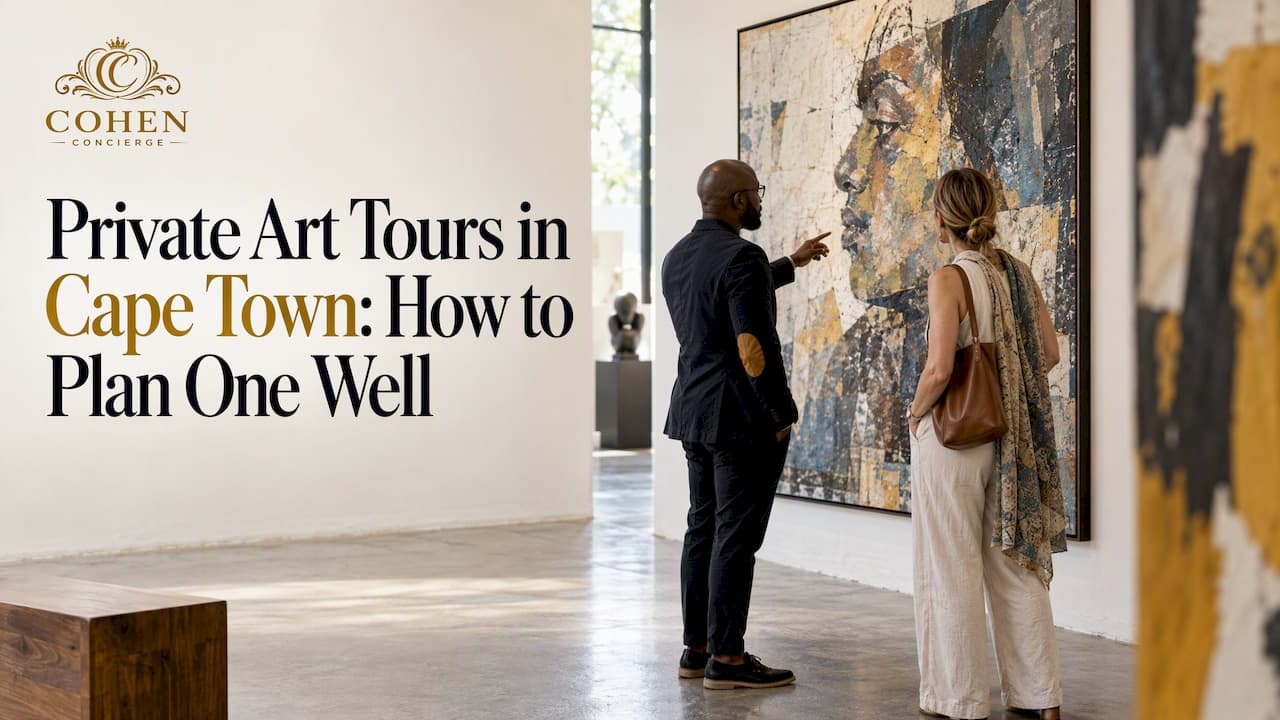
A good private art tour in Cape Town is built around you, not around a route. You choose the theme (contemporary African art, photography, design, collecting or street art), a guide shapes the day around what is actually on the walls this month, and everything between stops, from the car to lunch, is handled so you spend your energy looking. This guide explains what to include, what to ask, what the main venues offer right now, and how we arrange it for guests.
TL;DR
- Anchor the day on one cluster, not the whole city: the V&A Waterfront silo precinct around Zeitz MOCAA, or Woodstock and Salt River for galleries and murals.
- The word "private" matters less than access and judgement: a guide who can reconfirm exhibitions, open doors and say what to skip.
- Zeitz MOCAA is open daily from 10:00 to 18:00, and the museum publishes a dedicated address for private-tour enquiries, so book ahead rather than turning up.
- Two to three hours per venue is plenty. A well-paced day is one morning museum, a long lunch, one afternoon gallery district.
- Tell us your interests, group, mobility needs and hotel or villa, and we arrange the guide, transfers and tables around them.
Table of Contents
- What a private art tour in Cape Town actually is
- Why Cape Town rewards a tailored approach
- The main stops, and what to know before you go
- Sample itineraries
- How to choose a guide
- Timing, pace and practicalities
- Our perspective
- How we arrange a private art day
- Pairing art with the rest of your trip
- FAQ
- Sources
What a private art tour in Cape Town actually is
There are three broad kinds, and they are often confused.
A guided slot with a private guide. You book a guide for a museum or a neighbourhood, usually for a couple of hours. It suits a first visit and a single clear interest.
A curated day. The route is designed around you: perhaps a morning at a museum, a studio visit, then a gallery conversation. The guide adapts to the live exhibition calendar. This is where most of our guests land.
A collector's itinerary. Built for people who may buy. It prioritises commercial galleries, dealers and artists' studios over blockbuster museum stops, and leaves room for unhurried conversation.

Whichever you choose, the useful question is not "is it private?" but "can the guide actually change the route when the exhibition does?" Museum programmes change through the year, so a fixed script goes stale quickly.
Why Cape Town rewards a tailored approach
Cape Town has a dense, serious art scene. Mark Coetzee, then executive director and chief curator of Zeitz MOCAA, described the city to New York Magazine as having the ingredients of a significant art centre: art schools, galleries, museums, private institutions and committed buyers. That breadth is exactly why a generic highlights tour disappoints. There is too much, spread across too many neighbourhoods, and the quality of the day depends on what is left out.
The art also carries history. South Africa Tourism presents the country's architecture and urban fabric as both creative achievement and the record of a complicated past. A guide worth paying for explains who made a work, whose histories it speaks to, and how neighbourhood change affects the artists and residents who live there. Murals as a photogenic backdrop is the version to avoid.
The main stops, and what to know before you go
Zeitz MOCAA, V&A Waterfront
The obvious anchor. According to the museum's visitor information, it is open daily from 10:00 to 18:00 with last entry at 17:30. From 1 September 2026, general admission is R350, and South African and African citizens can pay R199 on site with qualifying ID or passport. The museum also runs free one-hour public tours from Monday to Friday at 12:30, subject to limited capacity, and lists tours@zeitzmocaa.museum for private-tour enquiries. Check those details again before you travel, as admission and tour terms can change.
The 2026 to 2027 season is a good one for a themed visit. The museum's season announcement features IMPRINT, an artist-led studio residency bringing together Cape Town publishing collectives, and Turning Towards the Sun, a multimedia exhibition. IMPRINT is scheduled from 2 October 2026 to 2 April 2028. The programme leans towards artist-led publishing, film and media arts, and African and diaspora perspectives, so it suits a tour organised around a medium or idea: photography, moving image, print, identity or design.
The silo precinct and The Silo Hotel
The museum sits in the converted grain silo complex, and the architecture is part of the visit. Next door, The Silo Hotel displays a serious collection across its walls, floors and interiors. If you are not staying there, ask us whether a visit or a drink is possible; access depends on the hotel, and we confirm it rather than promise it.

Woodstock and Salt River
South Africa Tourism names Woodstock and Salt River among the city's art districts. This is where you find working studios, smaller galleries, design shops and the street art the area is known for. It rewards a slower, walking-pace afternoon with a guide who knows which doors are open and which artists are around. It is also the right place to talk about gentrification honestly, which a good guide will do.
Commercial galleries and collecting
For buyers, the conversation matters more than the walls. Charles Shields, director of Everard Read Cape Town, told Monocle that South African art is technically as strong as art anywhere and universal in its subject matter, and that roughly half the gallery's sales go to international collectors. The same coverage and the earlier New York Magazine guide point to a wider ecosystem across Woodstock and the city centre that includes institutions such as the South African National Gallery, A4 Foundation, Norval Foundation and the Association for Visual Arts. That New York Magazine piece dates from 2019, so gallery rosters and hours must be reconfirmed for any 2026 itinerary, and we do so before you leave your hotel.
Museums of history and memory
Art and history overlap in Cape Town, and some guests want both. The South African Jewish Museum accepts bookings for privately guided tours with a trained guide or the museum director. At the V&A Waterfront, the Chavonnes Battery Museum takes you below sea level to the original shoreline hidden since 1724. Neither is an art museum, but either can give a day built around art a deeper sense of place. If your interest is private museum visits more broadly, these are good additions.
Sample itineraries
These are starting points, not packages. We reshape every one around the guest.
A contemporary art morning and a long lunch (one day)
- Private transfer from your hotel or villa to the V&A Waterfront for opening at 10:00.
- A two-hour guided visit of Zeitz MOCAA focused on the current exhibitions and your chosen theme.
- A short look at the silo architecture and surrounding precinct.
- Lunch at a table we have reserved in advance.
- Free afternoon, or a short return transfer.
Woodstock studios and galleries (half day)
- Mid-morning pick-up and a drive to Woodstock, avoiding the worst of the traffic where possible.
- A walk through the district's street art, with context on the neighbourhood and its artists.
- Two or three gallery or studio stops, agreed beforehand.
- A coffee or early lunch stop and a transfer back.
The collector's two days
- Day one: a morning at Zeitz MOCAA to understand the continent-wide context, then an afternoon in Woodstock and the city centre for commercial galleries.
- Day two: a private conversation with a gallery team, a studio visit if an artist is available, and time to revisit anything you want to look at again before deciding. We can also coordinate shipping questions with the galleries, who handle this routinely for international buyers.
A family-friendly version
Shorter, more visual and with room to move. Murals, sculpture and architecture work better with children than long gallery rooms. If you need a sitter for part of the day while adults take a longer visit, you can look at vetted local au pairs and babysitters in Cape Town and arrange care directly with a family-focused platform before you arrive.
How to choose a guide
A few questions separate a rehearsed script from a tour that responds to you.
- Can you adapt to the live exhibition calendar? Programmes change, and closures happen. The guide should reconfirm before the day.
- Do you have private-access arrangements? For Zeitz MOCAA, private tours are arranged by enquiry with the museum itself, so ask who handles that and when.
- What will you leave out? A confident guide has opinions about what not to see.
- How do you handle context? Expect an explanation of who made the work and why it matters, not only what it looks like.
- Can you work around mobility and age? Ask about steps, distances and seating in advance, not on the day.
- Who pays for what? Clarify admission, gratuities, lunch and transport so there are no surprises.
Timing, pace and practicalities
Go early. Museums are quieter at opening, and you will have the best of your energy for the more demanding rooms.
Do not chain unrelated neighbourhoods. The V&A Waterfront and Woodstock are close on the map, but a walking route that tries to join them leaves little time to look. Pairing a transfer with one concentrated cluster per half day works far better.
Watch the season. In summer, mornings are best for walking in Woodstock. In winter, rain can change an outdoor plan, so keep a gallery alternative ready.
Allow for reading time. Two to three hours per venue is typical. Ask your guide to build in ten minutes to sit with one work you did not expect to like.
Buying art. If you are considering a purchase, ask galleries about provenance, condition reports and export paperwork before you commit, and expect the gallery to help with packing and shipping.
Our perspective
Most of the art tours we are asked about begin with the same request: "Can you just take us to the best place?" The honest answer is that there is no single best place. There is the best place for a particular person on a particular day.
We plan these days the way we plan any other request: listen first, then remove friction. A guest who loves photography does not need the same day as a family with teenagers or a collector with a free afternoon. So we start with a short conversation about taste, mobility and time, and then build the day around one cluster, one long lunch and a car waiting at the right door.
The point most guests do not expect: the transport and the table matter as much as the art. A beautifully chosen morning is undone by a forty-minute search for parking or a lunch with no booking. That is where a concierge earns its place. We reconfirm exhibitions and opening details close to the day, and we tell you plainly if something is closed or has changed, rather than rearranging it in silence.
We would also rather give you two excellent stops than six rushed ones.
— Jordan
How we arrange a private art day
We organise private Cape Town experiences, and art days are part of that. You tell us the theme, the group and the dates through our request page. We then propose a route, confirm access and timings with the venues, and arrange the extras around it: a private chauffeur for the day, a restaurant reservation timed to the visit, and an evening to follow if you want one. If the art day is part of a longer stay, our villa and accommodation concierge can coordinate the rest of the house too. We do not publish prices for these arrangements, so ask us for a plan and we will tell you what it involves. You can see the full process on how it works.
Pairing art with the rest of your trip
Art works well alongside the other things guests come for.
- Wine: a morning at the museum followed by a day in the Cape Winelands is a classic combination, though it is better on separate days than squeezed into one. See our Cape Winelands experiences.
- Dining: a late lunch near the gallery you have just left keeps the conversation going. Our dining and nightlife concierge books tables around your schedule.
- Hidden Cape Town: if you want to go beyond the usual stops, our blog collects 14 local favourites off the tourist trail.
FAQ
Can I book a private tour of Zeitz MOCAA?
Yes. The museum lists a dedicated email address for private-tour enquiries, tours@zeitzmocaa.museum, and runs limited free public tours on weekdays at 12:30. We can handle the enquiry, confirm the timing and arrange your transfers around it.
How long should a private art tour in Cape Town last?
Two to three hours suits a single museum or gallery district. A full day works if it includes a proper lunch and only one or two cluster areas. More than that tends to blur.
Is a private art tour suitable for children or older guests?
Yes, with the right design. We shorten the visit, favour sculpture, architecture and murals, plan seating and short distances, and tell you in advance about steps and surfaces so that nothing is a surprise on the day.
Can I buy art on a private tour?
Yes, and many guests do. Galleries in Cape Town regularly sell to international collectors, and a tour can include time for a proper conversation with the gallery team. Ask about provenance, condition and export paperwork before committing to a purchase.
How far ahead should I book?
As early as your dates are known, particularly for private museum access, a specific guide or a collector's itinerary over several days. Short-notice requests are sometimes possible, so send them anyway.
Sources
- Zeitz MOCAA: plan your visit
- Zeitz MOCAA announces upcoming exhibition season 2026 to 2027
- New York Magazine: The Gallery Hopper's Guide to Cape Town
- Monocle: Cape Town's New Wave, a guide to the city's art scene
- South Africa Tourism: the delight and complexity of South African architecture
- South Africa Tourism
- The Silo Hotel: art at The Silo Hotel
- South African Jewish Museum: tours
- Chavonnes Battery Museum tour