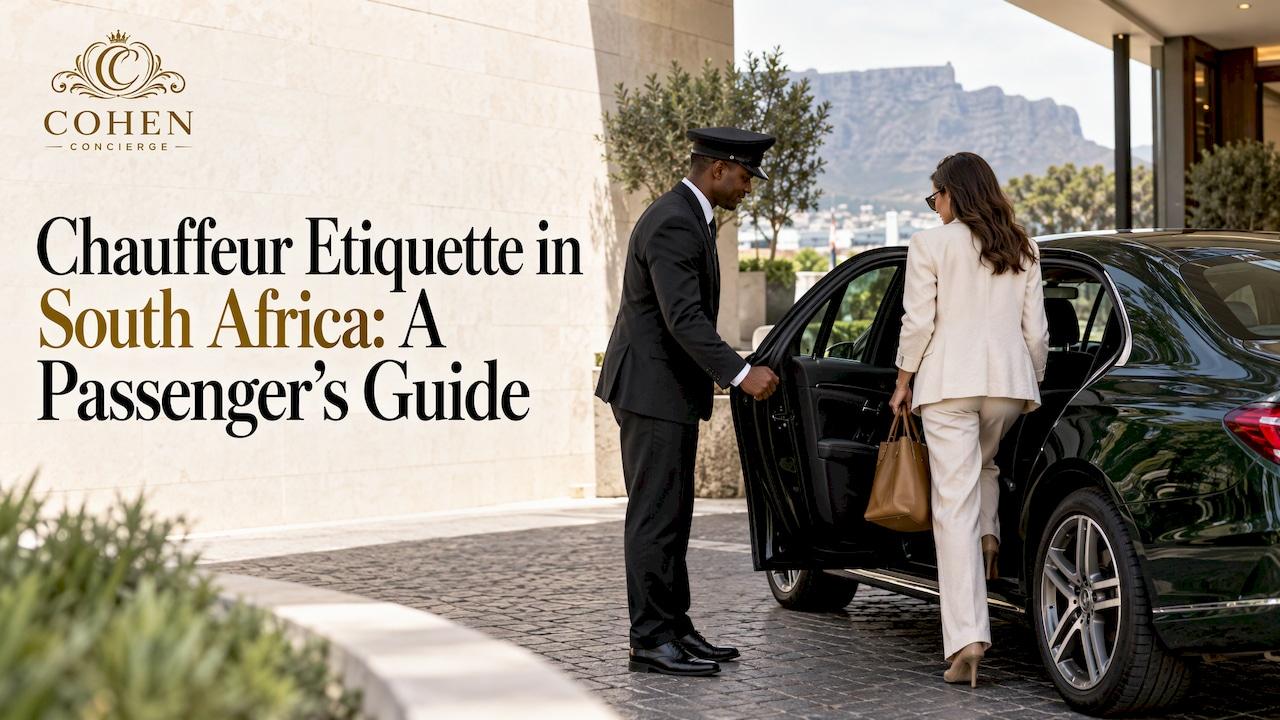
Good chauffeur etiquette in South Africa comes down to a few habits: greet your driver warmly, give clear timings and plans in advance, keep luggage and stops simple, treat what you say in the car as private, and tip in cash, in rand, at the end of the service. Follow those and the journey runs smoothly for you and your driver. Booking through a concierge makes it easier still, because the briefing, the timings and any changes pass through one point of contact. At Cohen Concierge, our private chauffeur service in Cape Town is built around that kind of calm, discreet arrangement.
TL;DR
- Greet your driver by name, with a handshake or a warm hello. South African courtesy starts with acknowledging people.
- Send flight numbers, addresses, passenger numbers and luggage details ahead, and agree stops and route changes with your driver rather than assuming them.
- Treat the car as a private space: conversation is welcome if you want it, silence is equally fine, and a good chauffeur will not repeat what he hears.
- Tipping is discretionary but customary. Cape Town Tourism suggests R50 to R200 per day for a private driver, in cash and in rand.
- Wear your seatbelt, keep valuables out of sight and let the driver choose the safest drop-off point.
Table of Contents
- Why etiquette matters more with a chauffeur than with a taxi
- Before the journey: booking and briefing
- Meeting your chauffeur: greetings and tone
- Boarding, seating and luggage
- Privacy and discretion
- Safety on the road
- Tipping a chauffeur in South Africa
- When something goes wrong
- Perspective
- Let us arrange your chauffeur in Cape Town
- FAQ
- Sources
Why etiquette matters more with a chauffeur than with a taxi
A ride-hailing trip is a transaction of a few minutes. A chauffeur booking is a relationship that can last a whole day, a week or an entire holiday. Your driver may collect you from the airport, wait outside a restaurant in Camps Bay, take you through the Winelands and bring you home after midnight. Small courtesies on both sides decide whether that feels effortless or awkward.
In South Africa the social tone is warm and personal. People greet each other before getting to business, and a driver who is greeted properly will usually offer more in return: local knowledge, a better route around traffic, a quiet word about where to eat. The rest of this guide covers how that plays out from the moment you book until the tip.

Before the journey: booking and briefing
Most etiquette problems start before the car arrives. They come from vague instructions. Give your chauffeur or the person booking for you the following:
- Flight number and arrival time for airport pickups, so the driver can track delays and be waiting when you walk out.
- Exact addresses, including the villa or estate name, gate codes and a reachable phone number. Many Atlantic Seaboard villas and Winelands estates have access control that a driver cannot get through without your host's help.
- Number of passengers and bags, including golf clubs, prams, surfboards and oversized luggage. The right vehicle is chosen from this information.
- Special requests: child seats, water, a quiet ride after a long flight, a stop for cash or groceries.
- Languages and preferences: if you prefer to talk, or to be left alone, say so at the start.
If you want the whole arrival planned, from the meeting point to what happens when you reach your accommodation, our private arrival planning guide walks through it. For the most common route, the airport to Camps Bay and the Waterfront drive times show what to expect at different hours.
Being on time, both ways
Chauffeurs plan their day around yours. Be ready at the agreed time, and if you will be late, tell the driver or your concierge as soon as you know. Cape Town traffic on the N2 and the M3 can change a schedule quickly, and a driver who knows you are running late can adjust the next pickup or the restaurant arrival time.
If you are the one who is waiting, a short delay at an airport is normal: bags take time, and immigration queues can be long. A driver tracking your flight will wait without fuss.
Changing plans mid-day
Extra stops, a longer lunch and a change of destination are all part of a good day with a private driver. The courteous way to handle them is to say so early. "Could we add a stop at Kalk Bay on the way back?" lets the driver check timings and parking, and it keeps the rest of your schedule realistic. If you are booked through a concierge, changes can be passed on in one message so that restaurant reservations and later pickups stay aligned.
Meeting your chauffeur: greetings and tone
Greet first. Etiquette notes for visitors to South Africa consistently stress warmth, respect and acknowledging everyone present, as set out in Travel Answers Group's South Africa trip notes, which also advise steering clear of sensitive subjects such as politics unless your host raises them. In a car that translates simply:
- Say good morning or good afternoon and use the driver's name. Ask how their day is going. It matters.
- A handshake is common. Offer one if the moment suits.
- Introduce everyone in your party, children included.
- Be natural about conversation. Many drivers enjoy sharing the story of their city. Others will take their cue from you and drive in silence.
On topics, travel is a good place to begin: favourite beaches, what you have seen so far, the food. Leave contentious politics and history for people who invite them.
Boarding, seating and luggage
Who sits where
In a chauffeured car, passengers sit in the back. The most senior or honoured guest usually takes the seat behind the front passenger, and the driver will normally open the door for you. Let them. For a mixed group of family and friends, you do not need a strict hierarchy, but agree seating before the vehicle moves so that no one is shuffling at a kerb.
If you are travelling alone and want to chat, you may be invited to sit in the front. That is a matter of preference. A professional will accept either choice without comment.
Luggage
Let the chauffeur load and unload bags. It protects your back and his, and he knows how to pack a boot so that nothing shifts on Chapman's Peak Drive. Keep with you anything you will need on the way: passports, medicines, wallets, phones and a jacket. Tell the driver about fragile or valuable items and he will handle them accordingly.

Food, drink and mess
Small bottles of water are normally provided. Eating a full meal or opening wine in the back of a car is not appropriate unless the driver has agreed or the vehicle is set up for it. After a day of tasting in the Winelands, bottles you have bought go in the boot, not rolling around the seats.
Privacy and discretion
Executives take calls in the car, couples talk freely after a wedding, and families discuss plans. A chauffeur hears all of it. The professional standard is discretion: nothing heard in the vehicle is repeated, shared on social media or described to other clients. As a passenger, you can help by being clear about what you need.
- If you need a private call, say so, and the driver will keep the radio off and the conversation minimal.
- If you do not want photographs or posts about your trip, mention it at the start.
- Do not ask your driver to share information about other clients. It signals that your own privacy would not be safe with them either.
This is also why many VIP and high-profile guests book through a concierge. Discretion is easier to guarantee when one coordinator deals with the driver, the villa and the restaurant. Discretion and a fast response are exactly what we promise at Cohen Concierge.
Safety on the road
A good chauffeur is also a safety measure, but passengers play a part.
- Seatbelts: wear yours in the back as well as the front. Drivers will often remind children and guests; take it as care, not criticism.
- Valuables: keep phones, cameras and bags out of sight when the car stops at traffic lights or parking areas, and do not leave them on the seat when you step out.
- Drop-off points: let your driver choose where to stop. If he asks you to wait inside until he has parked or opened the gate, that is for a reason.
- Alcohol: after a long lunch or an evening out, the point of a driver is that you do not have to think about driving. Plan to be collected rather than driving yourself.
- Night journeys: share your plans with your driver so he can wait close to the entrance and be ready when you are.
If something concerns you during a journey, tell the driver or the person who booked you. A professional would rather hear it early.
Tipping a chauffeur in South Africa
Tipping is not compulsory, but it is customary, and it matters to drivers. Cape Town Tourism's tipping guide, updated in March 2026, recommends R50 to R200 per day for a private driver or chauffeur. It describes tips as discretionary, based on service, and best handed directly to the person in cash in rand.
A few practical points follow from that:
| Situation | Sensible approach |
|---|---|
| Short airport transfer | Toward the lower end of the range, handed over at the kerb |
| Full-day private driver | Toward the middle or upper end if the day involved extra stops, heavy luggage or long waits |
| Multi-day booking with the same driver | Tip per day or give a single amount on the last day, in cash |
| Excellent, flexible service | Go above the range if it made your day |
Carry small rand notes. Foreign currency is awkward for a driver to change, and a tip through a card machine rarely reaches him directly. Thank the driver personally as you hand it over. If you are unsure how tipping works elsewhere in the country, our guide to tipping etiquette in South Africa covers restaurants, porters and guides too.
If you compare notes with travellers from other countries, you will see that tipping customs differ with distance and country. This guide to airport transfer tipping shows how distance affects gratuities in another market, which is a useful contrast to the South African norm of a modest daily amount.
When something goes wrong
Even well-run days have hiccups: a car arrives late, a route is closed, a request was misunderstood. Raise it calmly and early, and with the person best placed to fix it. If you booked through a concierge, report it to the concierge rather than argue with the driver on the road. It keeps the mood in the car pleasant and lets someone else sort out the details while the driver concentrates.
Perspective
Etiquette is really about removing friction. When a guest has told us the flight, the address, who is travelling and how they like to be driven, the chauffeur can spend the whole journey being attentive instead of guessing.
That is why we think the best chauffeur experiences start with a conversation before the car arrives. At Cohen Concierge we focus on a discreet, fast response and a network of luxury partners, so that a transfer, a dinner reservation and a villa arrival fit together instead of being separate bookings.
Our advice to guests is simple: greet your driver, tell us what you need, and let us handle the detail.
Jordan
Let us arrange your chauffeur in Cape Town
If you are visiting or living in Cape Town and want transport that runs to your schedule, our Cape Town airport transfers and private chauffeur service cover arrivals, day trips, dinners and Winelands days. Tell us your plans, and we shape the rest of the itinerary around them.

For the full picture of what we arrange, from private chefs to yacht charters, see our luxury concierge services in Cape Town.
FAQ
How much should I tip a private chauffeur in South Africa?
Cape Town Tourism recommends R50 to R200 per day for a private driver or chauffeur. Tips are discretionary and reflect the service you received. Hand the amount over in cash, in rand, directly to the driver.
Should I sit in the front or back of a chauffeured car?
The back is the norm, and the driver will usually open the door for you. If you are travelling alone and would like to talk, you can sit in front if you prefer. Either choice is acceptable.
Can I ask my chauffeur to make extra stops?
Yes, and it is best to mention them as early as possible. A short stop for a photo or a coffee is simple to add. Longer detours can affect later pickups and reservations, so tell your driver or concierge so that the rest of the day can be adjusted.
What should I do if I am running late for a pickup?
Contact your driver or concierge straight away. With the new time, the chauffeur can adjust the route and any following bookings. For airport arrivals, a driver who tracks your flight will normally adapt to delays on his own.
Sources
- A Guide to Tipping in South Africa, Cape Town Tourism
- South Africa Trip Notes, Travel Answers Group
- Airport Transfer Tipping: What to Give Your Chauffeur